Showing posts with label Motivation. Show all posts

Wednesday, July 06, 2022

The Why of Learning

Ged from the Earthsea Quartet, is one of my favourite fictional characters. In that world, you gain magical powers over objects and lifeforms by knowing their true names. His training is an extended period of study in a tower away from the noise. Then embodying that knowledge, so he doesn’t just know the names superficially. He sees them, recognises them, remembers them, and can use them as automatically as breathing properly. 

In David Copperfield, Charles Dicken’s character also finds a key to financial security through wrestling hard with something deeply complex and confusing until it comes naturally. In this case – Shorthand. This is a symbolic writing method that lets you take verbatim notes but write quickly enough to keep up (before there were keyboards and recordings). 

I have been plugging away at languages and the Rubik’s cube, as a tool for memory work. You can learn how to solve a Rubik’s cube in a few minutes (to solve) in an hour (to learn). To get faster, you need to put time and practice in. 

For a Rubik’s cube... why? You are not going to make money out of it. You would need to have another reason. With Languages, there is a payback as an entry ticket to other cultures and world views. To be able to connect to people in the way they are most relaxed. 

Yet... normally it would require a real push for motivation to get through the obstacles. Perhaps moving to a place where that language dominates. Perhaps a loved one. 

The why of learning is the key to deep soaking. I know why I spent time learning the Rubik’s cube. It is hard to explain or justify to others. You don't need to explain your why to yourself, but it needs to soak deep enough to overcome attempts to shift your attention away.


Wednesday, September 23, 2020

Competitive Wiring

I don’t want what I am supposed to want. I have a competitive wiring, so people who have known me in previous incarnations will have seen my crazy eye when I choose to go for it. Even when my skills, knowledge or ability aren’t 100% up to the task. We back the underdog over meritocracy, or we would be wired to roll over and play dead. A school buddy teases me about shouting, “we can still win this” at 78(ish)-0 playing Maritzburg College. We lost 111-0. But when I am the me I like, I try find ways to wiggle out of the nonsense. I don’t want to play in a world where we are constantly weighing and measuring each other. In a way that stops us seeing each other. Where the quality of our lives is determined through regular sortings and divisions. Where we cut each other loose like gangrenous limbs when we can’t reach common cause. I want more than that. Part of that comes from acceptance. I know. I am trying to work out what I can and what I can’t accept.

Competitive Wiring


Wednesday, February 20, 2019

The Right Incentives

Whether you are in politics, education, academia, business or the home, most of what we do ends up being about people management. Management of ourselves, and management of the way we engage with others. Why do we do things? What drives us, and what pulls us? Incentives and processes that will bring out the best in us. What does the best mean? Do we agree? Are we working with or against each other? In "All Marketers are Liars", Seth Godin argues that we are all Marketers. If you have an idea you believe in, you need to be a Marketer. All Marketers are storytellers. We are all storytellers.

Two stories I have come across are forms of incentivization that contrast quite strongly. The "Wolves at the Door" and the "Money off the table" approach.

The first turns the heat up. It works for underconfident overachievers. The idea being that in order to get the best out of someone, you have to put them in a corner and keep them hungry. Nothing is every good enough. There is always more to do. There is always something you got wrong. There is never cause for celebration that does not come with a caveat of "must do better".

The second turns the spirit up. It works for people with deeply internalized motivation. The crude incentives (like money, promotions, prestige) are no longer important because there is something else that gets the person out of bed. Things are good enough as they are. Sometimes there is nothing to do. Mistakes are simply a positive part of the learning process in that they mean you are exploring rather than repeating. They are a sign of life. There is a pulse of celebration.

Personally, I don't work well in a corner. I recognize that some people love it. Anxiety, busyness, and a tinge of fear keep them sharp. Fight mode. When that fire goes away, the systems switch off and motivation is a challenge. A lot of people look for corners.

I have the opposite response. I believe there is seldom value in rushing. Sometimes the smartest thing to do is just keep quiet. To admit you don't know the answer, and it will take time to explore the options. To chip away slowly at the problem. Start early and breathe.

Wednesday, January 09, 2019

Peddling Discontent

Our imaginations are both our most powerful tool, and our greatest enemy. We can imagine change. Very specific change. We aren't capable of the level of complexity required to imagine what that would actually be like, and how we would actually get there. We struggle enough with understanding now. Our bluntest motivational tool is imagining where we want to be, that isn't here. What we want to have, that isn't here. I believe it starts here. Massively reducing our ambitions. Accepting where we are, then taking really small achievable steps, every day. Park the rage. Park the spinning ambition. Use your senses to really understand your small corner of the world, and be connected to those around you. Breathe. Ask. Listen. Give. Celebrate the average. Celebrate the things you have. Chip away at the obvious obstacles. No one else understands what is going on either. We are all trying to make sense and meaning of it all.


Work on the problems you can solve

Friday, August 11, 2017

Compare to Yesterday

When we are constantly building, there can be a debilitating feeling of spinning the wheels. Bill Gates said, 'Most people overestimate what they can do in one year and underestimate what they can do in ten years.' I am a big fan of Tim Minchin's idea of being 'micro-ambitious'. Little goals add up. Slowly, until you look back and see how far you have come. Big goals just freak us out, because frankly, we are not in control of the path, and deep down we know that. We are good at fitting stories to the past. At coping. We have a fair amount of ability to control the next step. We can remember our last step fairly well, without too much retelling the story to make ourselves feel better. So if you compare, compare to yesterday. Do something that matters today. And repeat.

Friday, June 02, 2017

Personal Manifesto

It’s not about me

A focus on identity is a recipe for unhappiness. Identity is temporary and is a manifestation of our shared existence. I believe in an infinite world with no beginning and no end. A world I have no way of understanding and yet will continue to try understand. My deepest held belief is something I do not believe. I do not matter, but if I believe that, then nothing will matter. I stand for empowerment. The ability to see in others beauty and strength to which I aspire. I will define myself as someone who is unwinding his definition.

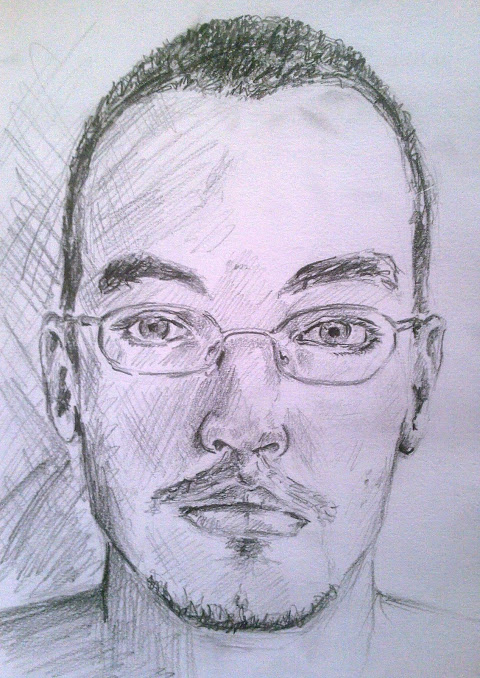
My drawing of a friend


It’s all about me

I can only understand the world through the tools I have been given. This includes my reality, the skills I have and grow, and the way the world interacts with me. Fighting this is not constructive. In understanding myself, I have the greatest ability to contribute. I have to look after the vehicle (physical self) and emotions (how I respond) to participate fully. I will continue to be curious, using the only fully willing ‘model’ to draw. All I need is a mirror. So I will not be afraid of the mirror. I will be a half-hearted fanatic, willing to give generously but fiercely defending the boundaries needed to protect my ability to give sustainably. I will not throw my life away. It is precious. I will also not live meekly. I will take calculated risk. I will let my emotions lead me where indecision would stifle my ability to engage. I will be brave. I will not fear death, I will fear not living.

A friend's drawing of me

Detachment

I will live my life by walking lightly and loving deeply. I work on built-in redundancy. Building resilience, and the ability to cope with whatever the world throws at me. When I face disappointment, I try and do something amazing that I couldn’t have done if that milestone had not happened. This doesn’t make me celebrate and enjoy the ‘dreams that died’ any less. I like to imagine infinite parallel universes in which anything that could have happened, did happen. This is just my opportunity to make the most of this particular random set of events. I try let go of the idea that everything happens for a reason. Reasons are added in hindsight. Detachment helps give life meaning rather than having meaning given to me.

Self-Portrait (2000, 2001 & 2002)

Empathy

I am not a bat. I can not see through the eyes of a bat. It is not possible for me to imagine being someone else. I can only imagine myself in their world. It is not possible for me to let go of my own tools of understanding. It is worth trying. We have wonderful imaginations and can expand our realities by learning the tools of others. By finding a way to connect to and enrich our worlds through others. That is one of my primary motivating factors. Curiosity to expand my ability to see.

Creativity

I do not believe creativity is purely about bringing visions to reality. It is a conversation. A dance. A relationship. I try be an active participant in the world and celebrate what it has to offer. Creativity is cultivating the art of appreciation. Developing a deeper knowledge and mastery of the way different elements engage. Developing a deeper knowledge of how we communicate. Through words, music, drama, colour, line, form, phrasing, tone, silence, contrast, energy and warmth. Diving into creativity is the source of our ability to thrive.

Acceptance

There are 7.4 Billion people on the planet and too many problems, even in my own family, even in my own life, to sort out. It is not my job. I am not able to sort out the worlds problems. There will always be challenges. There will always be pain, sadness, suffering and darkness. That is part of beauty. Developing a life approach where I feel comfortable with the balance between appreciating the world for what it is, and nudging it in a way that adds and sustains value.

Relationships

I believe the heart of understanding is tangible connections. In intimate relationships, we can develop an understanding of things that goes beyond the conscious. That taps into our Tacit Knowledge. I treasure, cultivate, and invest in relationships. I experiment with ways to grow and sustain my connections to others. I learn how people communicate, and how I can best communicate with them. I want to help build communities, and believe that starts with individual connections.

Empowerment

I hate Archy. It drives me bonkers. I believe in empowerment rather than power. I do believe in rules, but as a tool. Rules are simply the consciously understood terms of engagement. If the rule is not followed, it is not really a rule. I try manage this by lowering my expectations of others, but being generous in what I give out. In accepting that other people’s irritation and disappointment is their own to manage. This is counter to my natural emotional wiring which is a ‘Saviour Complex’ and a hatred of ‘getting things wrong’. The only thing I can control and impact is my own emotional world, and my own actions. I take responsibility for that. I will shift my Saviour Complex to an Empowerment Drive.

Tuesday, May 09, 2017

Work Ethic

While I am not religious, I grew up in a very religious community. It has been interesting moving from South Africa in which Church life plays a big role in people's life, to the United Kingdom, where it doesn't. Despite the lack of church attendance, many of the cultural aspects are deep soaked. 'White Anglo-Saxon Protestant' (WASP) culture is still very recognisable. A big part of this culture is 'God helps those who help themselves'. A belief that you can't just pray for things. You have to crack on and get it done. A belief in self-reliance, self-motivation and not looking for excuses or support.

Self-reliance is empowering. It forces you to look inside and do what you can, with what you have.

The problem is, we aren't aware of all the support we have received. Christians may refer to this as 'God working in mysterious ways'. Where we were born, who our parents are, our schools, the social capital of living in a functional country, our natural talents, the random experiences we have be lucky enough to be exposed to.

A push back on a 'sense of entitlement' that leads you to waiting for hand-outs is at risk of ignoring all the 'blessings' we have received. Ignoring our privilege. 

I believe Meritocracy/Privilege is close to 1. In other words, we can't take credit for much of what we achieve. Yet, feeling we can take credit is incredibly motivational. Stopping making excuses is a powerful driver.

I don't believe Universal Basic Income is a handout. It is a sharing of blessings that doesn't remove any of the incentives to do more. Having the basics required to work doesn't disrupt 'work ethic'.


Friday, March 24, 2017

In Praise of Mediocrity (Tim)


I am the product of excellent schooling during an era when white South Africans were uniquely privileged, so it’s hardly surprising that I know some very ambitious and successful people. What’s surprising is that a few of us are not particularly ambitious, nor are we successful in the conventional sense of the word. What’s more, in the fifteen years that I’ve lived my life as an itinerant English teacher, I’ve met a lot of other unambitious folks, and they are a breath of fresh air.

It’s only human for us evaluate our lives through a critical lens from time to time, and I suspect that many of us feel like we are falling short of some kind of ideal. That’s because now more than ever the media and popular culture are peddling the dogma that we must wring the very last drop of effort out of our lives to ensure that we are the best that we can possibly be. Mere happiness is no longer sufficient; only excellence will suffice.

If that obese 65-year-old woman with one leg can do it, then you had better get off your arse and run a marathon too. If all it takes is hard work, why haven’t you learnt to brew your own beer from raw ingredients, or write your own computer program? Basically the implication is; why are you content with your mediocre life? It may not be that explicit, but the ‘Just do it, Impossible is nothing’ mantra is telling you that the only reason you don’t have a Ferrari in the garage, and six-pack abs is lack of effort. So, by extension, you should feel guilty about it.

By the bizarre standards of our hyper-ambitious age, you should feel guilty about not working overtime, not losing sleep, not sweating blood to achieve ‘exceptional’ goals. You should feel guilty about being merely content. Well, I’m here to tell you that that’s bullshit. What exactly is this ephemeral ‘excellence’ that we’re supposed to be aiming for? How is it better than contentment? Surely the ultimate goal of all our effort is just happiness. 

Survival is good enough

The great lie of advertising is that you need more stuff to be happy, and thanks to an onslaught of likeminded media, even some as benign as TED talks, we’re all infected by the idea that if we can just reach that goal of (fill in the blank), then we’ll be happy. But of course, this is nonsense. Why peg your happiness on some future state when you can be happy in the present? All you have to do is appreciate what you have.

Appreciation v Progress

I’m not saying that goals are pointless, but I do suspect that our grandparents’ generation was happier in many ways because they knew how to be content. They knew when they had enough stuff, and they appreciated the simple pleasure of spending time with family and friends, or just being alone, doing nothing in particular. To those of you who are happy with your lot in life, and are content to keep it that way, I think you have achieved the goal that many ambitious souls are longing for.  To the contented mediocre, I salute you! 

Wednesday, April 13, 2016

Surviving (with Christie)

One thing the bubble I grew up in didn't lack was female role models amongst my peer group. From my mother, grandmother, aunts, cousins to friends and mentors, I have always been in a world where women have excelled. Whether learning languages, conquering statistics, coding, teaching, listening, communicating with authority or managing people with inspiring empathetic skills. I went to a single sex high school, but up to the age of 12, the girls dominated us trouble causing boys. At university, I was in a single sex residence but our sister res was just next door. We shared meals, classes, life and debate. One of those inspiring people I met was Christie Roberts.


Trev:
Hey Christie, I hope you are happy and smiley. Was wondering if you fancied doing a guest conversation or guest post for my blog? 

Christie:
Thanks Trevor. I would be keen...where I can find time during Luca's brief naps 🙈 My only disclaimer is that I don't feel like I'm very "interesting" right now - hardly reading, barely thinking and a stay-at-home mom (indefinitely) but let me know more about what you have in mind and let's see where it goes... it's ironic you speak about being "smiley happy" - I am doing well and overall feeling happy but have actual struggled with postnatal depression - probably one "cause" close to my heart as I'm living it out... 

Trev: 
I don't have kids but get to spend lots of time with friends who do. Although I know actually being in it will be harder, I don't have the wool over my eyes in terms of how hard it is. Dan Gilbert talks about parenting in 'Stumbling on Happiness' as one of those entire life choices where the early part is very hard work. A friend I met with in San Francisco was in the 'crazy eye period' and told me how much he had learnt about unconditional love. He puts all he has into the relationship with the child, and can't expect love in return. He gets incredible moments, but he says it has given him a whole new sense of appreciation for his parents. He has started trying to make more time for them. 


Christie: 
Absolutely - our whole concept of love is challenged - this little creature with such basic needs that you need to meet, that can only communicate and process the world through crying. It's only as they grow a little bit that one starts to get the "rewards" of a relationship: smiles, laughter and sounds that make a baby feel more like a little person. 

It's also such a huge transition for someone used to order, predictability, structure and validation from ones work. Especially having worked in the research arena for the last few years, one of my main tasks is data cleaning and quality control - things are either right or wrong, and one applies basic problem solving to resolve conflicts. Now you're in a world where there is no schedule, no predictability, no control and no validation. One can't manipulate or problem solve a baby. One has to learn flexibility, to surrender to the chaos, to relinquish control and accept that one is to take a supportive role - and to tap into a more intuitive part of oneself. 

It's a huge life lesson. And it involves a massive shift in identity. I can't believe how much I am learning about myself through this experience. A baby is mirror - forcing one to see ones true self. It's deeply confronting.  

Trev:
Although each parent-child dynamic I have witnessed is unique, there are some parallels that make me smile/cringe. I particularly enjoy the 'emperor voice' some kids get as they still haven't quite conquered their pleases and thank yous. The world they see is the only world there is and there isn't the perspective adults perhaps take for granted. Then there is the little fact that our brains aren't fully formed till we are about 25, and that is still just the machinery. Parents arguably get to deal with us at our worst and may have to wait till we are parents ourselves till they realise the effort required. It seems to me the important elements are still looking after yourself and hopefully being lucky enough to have a support network. Although some of my friends say it is just a period of warfare you need to get through with as few battle scars as possible. 

Christie:
There definitely is a survival period - I think we are just emerging from that - the goal is to purely meet needs: feed, clean, hold, put to sleep. What has been so interesting to me is to see "nature vs. nurture" at work. While it is important for us to create and sustain a nurturing environment for our children, so much of who they are is not dependent on us. For example Luca was not a sleepy newborn - he was born with eyes wide open and he has been very aware and engaged in his world from the beginning. At first we were frustrated that he didn't fit the mould of what a newborn should (or should not) do - but as time has gone on, as we have gotten to know him better, we realise that this has nothing to do with us, with parenting failures but rather that this is how he is wired. So we are starting to accept that our (emerging) social butterfly, will not lie passively in the pram while we wander around the shops. He wants to be at eye level - in our arms, facing forward in the baby carrier at our chests - engaging with the world and its inhabitants. It's liberating to know that we have not succeeded nor failed in our parenting: he is who he is regardless of what we do. So we have to learn to embrace that our our role is to help facilitate the best version of who he is, rather than being responsible for "making him good".  

And there is a joy and reward in that: discovering more of who he is as he grows and learns more about himself each day. It's both fascinating and fulfilling to see his daily development - not just in the obvious milestones of walking, talking etc but in his perception of the world - from being a passive observant to seeing relationships between people and things, being able to engage in a game and to discover his sense of humour. 

Nature v Nurture

Trev:
It is interesting that the survival period sometimes relies on skills we feel we have been able to specialise out of. For the purposes of a job, we can outsource administration. We can outsource chores. We can outsource anything that isn't our core competency. When it comes to parents, they are all in. They need the soft skills of knowing which fights to pick, and when to dish out affection. They need the tone of voice and confidence to set clear boundaries. They need to clean and act as a servant to the little majesty! There are lots of things we do for ourselves that ordinarily we wouldn't do for other people. Enter children and any traditional motivations get flipped on their head. It really is the best example of a Gift or Sharing Economy we have. Where the inconsistent and independent reward comes in those moments of joy, discovery, learning, engagement and humour. 

(I am enjoying this conversation - I think the people I have spent time with would love to hear some of the insights you are having! Funny how it started with you saying you don't have anything interesting to say, and then all this awesomeness gushes out) 

Christie:
Haha - it's a symptom of my Type A comparison syndrome that lets me tell myself "I'm just a mom" while other people are conquering the world. My world has shrunk and I am aware of how monotonous and mundane my days can be - menial labour sometimes - which, as you mentioned before, can be quite humbling for someone used to functioning at a different level. There is no outsourcing of changing nappies, mopping up vomit, pee and poo. It's messy at the coal face of child-reading and there's something quite special about that too: the great leveller - it's so basic, so primitive that one feels connected to parents of the world. This universal connection that comes with his rite of passage. 

And it's so comforting to know that we are not the first, nor the last people to struggle with this transition. While it can feel incredibly personal (symptomatic of isolation), the experience is so universal. Perhaps the most universal - there will be differences in approach, to how children are wired etc. but there are some common themes that all parents struggle with. And all parents have to find their own unique way to deal with their unique challenges but the struggle is shared. 

I take no comfort in the people who find it easy but rather in those who struggle - both with the physical aspects as well as the mental and emotional shift. And it's so freeing to know that it is normal to struggle. And one learns to give oneself permission to be imperfect. To accept and surrender to the chaos. 

And with that baby wakes up and my thoughts are interrupted 🙈🙈🙈 

Trev:
It is funny. I have actively chosen to step out of the world conquering and narrow down to more simple 'micro-ambitious' tasks like learning to cook and domesticating myself. I really didn't like the corporate world structure of pay and hierarchy determining whether people had 'done well at life'. I was also worried about how much of the success came from privilege and randomness. I worked hard, but working hard seems partly a random skill too! I recently wrote a post wandering what would happen if 'the rain came'. If we were all paid a Universal Basic Income that gave us financial freedom. That equaliser would mean everyone chose what they did based on incentives other than what we are used to. Parenthood seems like a great equaliser too. Whether you are a Billionaire or a Single Unemployed Parent, you are the custodian of a life. A little person who still has to learn EVERYTHING. Including that you are a pretty big deal. 

Christie:
I had already taken some steps back from work before Luca arrived - working in research projects where I had flexibility. Over the years I have learnt more about my capacity and preferences - that working in clinical medicine wasn't going to be my future but rather to find other avenues where I could put different skill sets to use and that would energise me. I still have to fight the natural desire to think less of myself. And parenting has really revealed how hard on myself I truly am. My big challenge at the moment (working through with a therapist) is how to be kinder to myself, to extend myself grace. If I don't, then I end up treating parenting as a performance and both Luca and I suffer as a result. I can only treat him with kindness, patience and love if I learn to treat myself with the same measure of respect. Easier said than done. 

Trev:
Yes, a lot of the stories we tell ourselves to cope sound amazing and then are ridiculously hard to put in practice. I think we are also in a rush. There is a Jewish saying that 'life begins with the kids move out and the dog dies'. A lot of jobs are probably best reserved for people with gravitas and wrinkles. I think we should probably only start working when we are 50! My mother, aunt, and father's wife all went back to university in the last decade and have launched new careers. I would rather get advice from, invest my money with, or work with someone who has been punched in the stomach a few times by life and carried on. The strongest people in my life have been women, and that is no doubt because the responsibility of parenting used to fall largely on them. I learn a lot by spending time with my friends who are parents. Thank you.

Doing Well, Being Well

My bubble has an underlying guilt motivator. A cultural wiring of hard work and earning what you get in life. There will often be conversations about whether someone has 'done well' in life. The measures are usually external. Salary, responsibility, authority, conspicuous wealth, titles, degrees or any other signals that you have earned respect. That you aren't seen as a loafer. That you aren't a parasite on society. That you are adding value.

One of the aspects of privilege that I am aware of is that I can opt out of this. I don't consider everything I do as a reflection on other people. I don't consider what they do as a reflection on me. I don't identify with my narrow group. White, male, 25-54, english-speaking, university educated, Top 1% of the global wealth (when I was working, just outside that now that I am not), and a citizen of both South Africa and Britain. I don't come from any oppressed group other than being the youngest sibling. I am significantly taller than my oldest brother, so I am at an advantage in pushing back. When you are part of an oppressed group, I can see the appeal of identifying with that group and proving that they are equal to all. Part of my privilege is that I don't have to.

Tall and Short

My problem with 'doing well' as a measure of success is that it is relative. It also requires external signals that can be measured. As soon as you have to display progress, a lot of energy ends up being put into marketing. Energy gets put into influencing and getting recognition. This ends up attaching expectation to everything we do. I don't like that. I like the idea of being able to do things for their own sake. I like the idea of being able to dive into the internal stuff. The stuff that can't be measured. The stuff that can't be held on to.

I like the idea of being well.

Sunday, April 10, 2016

More Kews

I grew up amongst a few monsters. Their names were Carlton Ave, Dawncliffe Road, and Kew Avenue. The fact that Vista avenue was the choice is like a Republican choosing between Trump and Cruz. My excuse is that I moved age 13, but my block of choice was just 1.8km. Just over a mile. I could be done and dusted with any training I was doing before people knew I was gone. I knew that instead of Vista-Trevor-Carlton (loved that I had my own road nearby), I could brave Vista-Hillside-Cotswold-(Kew-)Carlton, but I left that up to my big brothers. You only added Kew if you were nuts. Even cars struggled with the climb. The hilly nature of Westville shrunk my world to about a 5km radius. The beaches of Durban were 14km away and became a rare visit.

Trevs, Trees and Hills

I often tried out for things. I would have been called a 'Try Hard'. I seldom really trained hard. With my body changing so much, I figured maybe I will have become good at something that I wasn't good at the year before. I would sometimes make the reserves of the B team for athletics. By pitching up for practice week after week, someone would fall out and I would get a chance to run in the team. Or jump. Or throw. Whatever team didn't have enough players.

About a year and a half ago, I read 'Born to Run' in which one of the main characters is Scott Jurek. He is like the Lance Armstrong of Ultramarathons without the money, and without the drugs. The interesting thing is that he wasn't ridiculously awesome at short distances. He just enjoyed it, and carried on doing it. His trick was that he didn't do a little less than those who were talented. He did a little more. The theory being that if you want to do well, just carry on running. People slowly drop out.


A friend of mine who is ridiculously spider-like on walls and has ranked highly in both South Africa and the world said he wasn't very good to start. He just carried on. Jurek's best marathon time is 2h38min. That isn't very quick. The world record is 2:02:57. Jurek just carried on running. My friend just carried on climbing.

I don't regard myself as even close to a natural athlete. I have always spent more time on reading and creative pursuits than exercise. I will admit to buying into the western separation of the body and the mind. This can lead to exercise feeling a little like a distraction from work or study. I now believe the opposite. That if you just treat your body as a transportation devise for your head (see Ken Robinson), your head won't work as well. So I am chipping away at the years of sitting at a desk slowly.

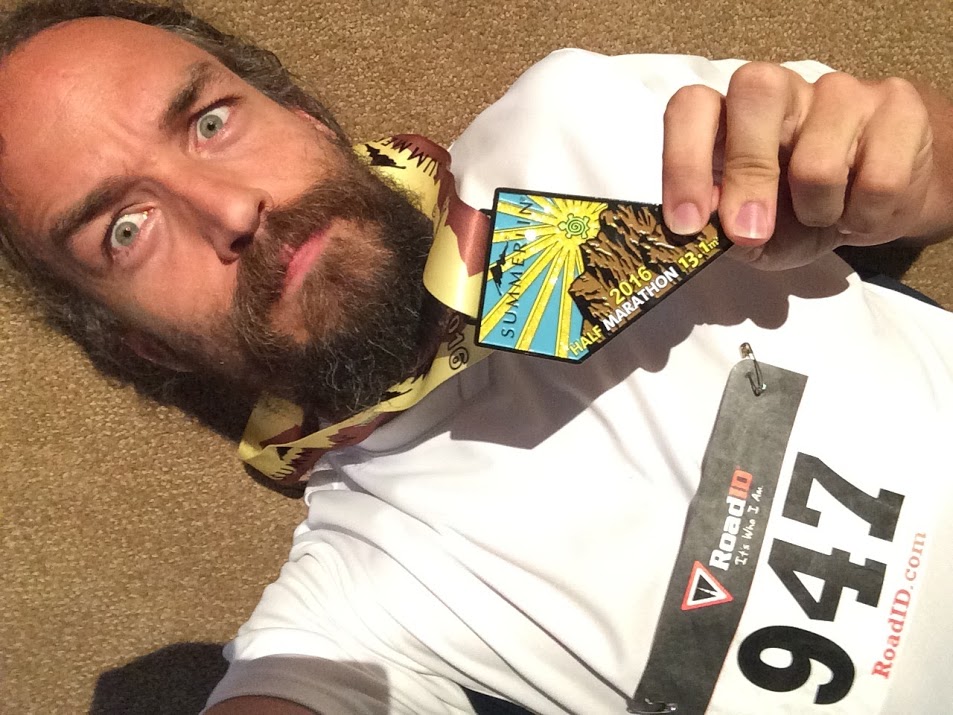
Today I ran my first half marathon in Las Vegas. In two weeks time, I will be attempting my first marathon, with my brother, in Stratford-upon-Avon (The Shakespeare Marathon). I really enjoyed seeing the range of people running, and the range of goals. The winner shot home in 1 hour and 10 minutes. More impressive to me are the people still coming home well after Jurek would have finished a marathon. Pushing on after 3 hours. Trying to catch the person in front of them. Just trying to run the next 100 metres before thinking about the following 100 metres. I tried to run while keeping my breathing ok. Feeling comfortable till I got to halfway. I then focused on the runner in front of me... using my breath as my pacemaker. If someone past me, I tried to pass two people. Chip. Chip. Chip. 

On the floor after my first half

My goal wasn't competitive. My time would still make me reserve for the B team, waiting for someone to drop out. But by taking on more hills, more Cotswolds, and with the help of my brother, more Kews, whether or not I regarded myself as an athlete at the start is irrelevant. I will be able to run further, with more comfort, and expand my world beyond a 1.8km block. 

Take the Kews life presents.

Wednesday, January 27, 2016

A Decision

Progress is hard wired into motivation. A future, superior world, where we have more, are more, do more. Deciding you have enough financially, is empowering. Deciding the way you spend your time now is enough, is empowering. People worry that absent the fire of a target, we would fizzle out completely. That is how we have been trained. What do you want to be? Not, what are you passionate about now. What are you building towards? Not, who do you want to spend your time with now. Sometimes it isn't about a plan. It is about a decision.

Bringing the Motivational Fire Inside

Tuesday, January 26, 2016

Shifting Motivation

Two of the major motivational tools at work are Salaries and Grades. A 'promotion' usually involves one or both. Most see a different job that pays the same as a rotation, not progress. Promotions usually involve more money and/ or less time. A company/charity/university may not formally use Grades, but we are pretty good at sniffing out which jobs have more responsibility. Either there is more work, or more people whose work you are directing.

Lifestyle outside of work becomes very dependent on lifestyle at work. There is a knock on effect. A raise increases your 'standard of living' because you can spend more. It may also increase your stress because you have less time to spend. For people who love their work, and choose to devote their energy to it, this isn't a problem. What concerns me is how much everything is driven off that. I would love to see a decoupling.

One of the best savings techniques is to focus not on the number coming in, but the number going out. The 'Save More Tomorrow' plan introduced by Richard Thaler allows employees to sign up to save an increasing percentage of their raises in the future. We find it easier to plan to start running tomorrow. Dieting tomorrow. Being good tomorrow. The advantage of this plan is that there is no adjustment to lifestyle. The increase is just smaller.


I like this idea. I think it can be taken a step further, if your lifestyle depends on spending better, rather than spending more, the number can stay the same or decrease. If increases all go somewhere else, the power that promotions have over your life decreases. Decide on the number you need, not what you get. Ideally work on the number you have already. Aim to spend less, not more. Once you realise you already have enough, the influence of external forces decreases. It doesn't mean you won't carry on doing the same thing. But drawing motivation inside is incredibly empowering.

Friday, December 04, 2015

Managing Energy

While on Table Mountain with two friends recently, we sat to take a break. In truth, two mountain goats sat to wait for a donkey to catch up and regain control of his breath. But the views from the top are spectacular and they weren't moaning. Suddenly one of them broke out into a passionate rendition of a beautiful piece of writing he had heard. The words were spot on for what John and I needed in that moment. When you spend lots of time thinking about all the the problems in the world, you can feel overwhelmed. It is much easier to pick something and crack on. The truth is, you need to manage your energy. You can't always be fighting or you won't have anything left for the next day. Galeo taught us the idea of the 'Half-Hearted Fanatic'. Always keeping something back for the moments, activities, places and relationships that feed you.

What was wonderful, is that he had internalised these words. Socrates didn't write. He thought this 'modern invention' would make people lazy. Even once there were books, the literate would studiously memorise them because chances were they would only see them once. To 'read' them again would require being able to close their eyes and recite the words in their heads. To chew on the words. To savour their meaning. It isn't good enough to know where to find something. When you are on top of Table Mountain with two friends in need of a boost, it is a powerful thing to be able to take a deep breath, and say...


"One final paragraph of advice: do not burn yourselves out. Be as I am - a reluctant enthusiast....a part-time crusader, a half-hearted fanatic. Save the other half of yourselves and your lives for pleasure and adventure. It is not enough to fight for the land; it is even more important to enjoy it. While you can. While it’s still here. So get out there and hunt and fish and mess around with your friends, ramble out yonder and explore the forests, climb the mountains, bag the peaks, run the rivers, breathe deep of that yet sweet and lucid air, sit quietly for a while and contemplate the precious stillness, the lovely, mysterious, and awesome space. Enjoy yourselves, keep your brain in your head and your head firmly attached to the body, the body active and alive, and I promise you this much; I promise you this one sweet victory over our enemies, over those desk-bound men and women with their hearts in a safe deposit box, and their eyes hypnotised by desk calculators. I promise you this; You will outlive the bastards."
Edward Abbey
HT Galeo Saintz 


Sunshine on the Table Cloth with Galeo and John

Sunday, November 01, 2015

Jedi Mind Tricks

A friend of mine claims I spend 60% of my time mastering Jedi mind tricks to pressure people into writing for my blog. His delays are just fighting the power. Unfortunately, the force is not strong with me. I won't lie, I love it when I get people who are keen to write guest posts. 

My aim though is to find how I can help. By writing every day, I have developed a habit. I was always amazed by the professional writers I worked with. John could have a conversation with people and, an hour or two later, send out a draft ghost written article that I would have agonised over for weeks. An Unogwajan Marathon runner I met, Tiago, had run 400 marathons. To the point where he just gets up and goes for a run like I make a cup of tea. He isn't killing himself. He enjoys it and his body has adjusted. Tiago and John have a habit.

We are all motivated in very different ways. We all like being reminded or encouraged in different ways. For some a reminder is a nag. Others actually like the structure of being in an environment where they are told what to do. Another friend of mine said he really enjoys being micromanaged. Being micromanaged drives me nuts. For him, he is able to completely outsource the icky motivational stuff and just get on with doing things.

I think we should be able to hire and fire our bosses. Like musicians or tennis stars. Find a team that helps bring out the best in you. The job of a boss should be to take obstacles out of the way. To find barriers to creativity and destroy them.

This is the guest blog post you were looking for, move along

Friday, June 26, 2015

Enjoying the Process

There is a strong conflict between our short term desires and the the view from the top of the elephant of where we want to be. Change happens very slowly but what we see, feel, smell, taste, and hear is right here and now. One proposed definition of happiness is an alignment of short and long term incentives. A story that makes sense. In 'The Happiness Hypothesis', Jonathan Haidt looked at professions where the aspects of something being a job (what you do to survive), a career (something you build) and a calling (something you value) align.


He looked at Journalists and Geneticists. The Geneticists felt like they were in a golden age. The work they are doing is rewarding in and of itself, it is valuable to society, and the financial incentives reward good work. They don't feel like they have to 'sell out'. The Journalists on the other hand were getting more and more frustrated. Anyone could sit and home and write a blog in their underpants. Formal media has become more of a big machine and more polarised. This is who they are competing with or working for. The sexy, scandalous, violent or shocking is where the (decreasing) reward is. Often in small, repetitive, digestible soundbites. Many would have been drawn to journalism as a founding pillar of democracy. A deep belief that free speech will keep people honest. A desire to bring the research of people on the boundaries of human thought back to the man in the street. The noble goals then get out of line with the short term realities and things fall apart.

We aren't very good at doing the things that are good for us in the long term if they conflict with the things that make us happy in the short term. It seems we know this and it bugs us. The trick seems to be to somehow get coherence. How can the small, achievable, daily goals that add up over time become something we do for their own sake. Some of us are heroes. The rest of us have to do the hard work and in truth, it just isn't going to happen. Just do it. Um, ok. Tomorrow.

If there was an effective diet that consisted of sitting on the couch eating fat, salt, and sugar while binge watching our favourite TV series - we would all be rippling muscle machines. The Rider can train the Elephant but I don't think it can be done without incentives. We can summon little bits of will power to make little changes here and there. Big changes compound over time and need sustained habit formation. For that, we need to enjoy the process.

We have to remember the Elephant is the boss.

Thursday, June 25, 2015

Today a Good Day

I like the idea of small, achievable goals that add up. Tim Minchin calls it being micro-ambitious. As soon as goals become very large, just taking the first step becomes very difficult. I also like the idea that the process is even more important than the goal. If we get incredibly good at looking towards some future point, our gaze is still on 'what next' when we are in the moment we have so looked forward to. In less than a years time, if my application is successful, I will be attempting the Unogwaja Challenge. Until earlier this month, I got to frame this as 'the year after next'. Safely enough in the future that the enormity of the task of cycling c. 170km a day for 10 days, and then running the Comrades Marathon is tomorrow's problem. But tick tock. Time waits for no one, no matter how hairy. It is now 'next year' I am aiming for.

A marathon is a long way. Even a half marathon intimidates me. The Comrades is more than twice that. Then there is the cycle bit before you get to the start line. That is the big goal. The goal that makes me sweat a little and people who care about me think I am nuts. I tell them, although not for charity, it is for a good cause. I am not trying to be a hero. I will not destroy myself. Apparently we only think running is bad for us because we spend most of our time on our bums, then try run. This confuses the body. We were in fact, born to run. Then I remember the figure of 170km a day. Ten days. Comrades Marathon. How to start?

So for the next bit, I am not going to think about the goal too much. I am just going to try and enjoy each day as I kuier with London. I am just going to include some walking in the kuiering. I have started 'Urban Hiking' and would like to try walk the length of a marathon in one sitting during the next week or two. I have done 10 miles a few times (one as a very slow run, breaking my distance record). I was staying in Norwood Junction and walked to Brixton and back. On another day I walked to Hoxton Square. On the way I get to see London just doing its thing. I have even, believe it or not, being getting quite a tan. I have also been zooming through Audio books.

A Running Track in Regent's Park I didn't know about

The idea of the Urban Hiking approach started when I went for a run without my phone. I was in an area I didn't know, and decided to trust my nose. I got a little lost and the run eventually became a walk as I tried to figure out my way back. Almost 4 hours later my hosts opened the door to a very tired, but inspired, newborn urban hiker. You can't really get lost in London. There are tube and bus stops all over the place. A cab could easily take you home. You could just run or walk map free until your body starts complaining.

Fancy joining the Circus?

Today's walk has lead me to Crouch End and 'Fifty Five' - a little coffee shop with savoury pancakes. They have free wifi. All these things make me happy. Yes, I am easy to please. My micro-ambitious goal was for today to be a good day. So far, so good.