Showing posts with label Empathy. Show all posts

Tuesday, April 05, 2022

I Am Not

Detachment isn’t finding a cave and not participating in society. It is partly about the conversation you have with yourself in your head. I have a friend who said to me, “You talk about yoga and are a yoga teacher, but I have seen you more wound up and angry than anyone else I know.” My inner conversation is often full of righteous indignation. 

The struggle over wanting to care, but both not having the capacity to care about everything, and not having the skill, knowledge, ability, network, influence, or resources to do anything about a lot of what I think should be different. 

Like many others, and definitely many other South Africans, I intentionally carry personal, historical, and global problems with me. If someone is stressed at the table next to me, I will soak that up. Like if you are sitting next to people breaking up in a public place. For most of us, the last few years of news and politics have been really difficult to process. 

Do you stay involved? Do you detach by turning off your connection to the internet? Do you detach by not having conversations with other people? Do you detach by creating an alternative reality bubble? 

I am okay with getting angry. Living with the full range of emotions we were given. Anger can be useful if applied in the right settings with the appropriate delivery. It’s a part of caring. The opposite of love isn’t hate, it’s apathy. When someone has absolutely no interest in you whatsoever, that can cut straight to the soul. Hate normally comes from a place where there is emotion and connection. 

Part of financial resilience is emotional resilience. We aren’t Spock-like detached rational human beings. We are connected to the world in an emotional way, which we need to acknowledge and learn from.


Thursday, January 17, 2019

Old Scripts

We speak too quickly for each word to be a conscious choice. The stream that bursts from us comes from deep beneath the surface. A reaction from within. We recognise the situation we are in from situations we have been in. From situations that have repeated themselves into our muscle memory, or burnt themselves into us through sheer force. Seeing things from other people's perspectives is so hard, in part because we haven't had their experiences, but in part because it is so hard to "unsee" what we have experienced. As the experiences soak in, we can forget them but they don't disappear. Accessing the scripts that drive us requires patience. It requires calm. It requires doing the work. This is why honesty isn't just letting down barriers. It is also making time. Understanding can't be forced.


Tuesday, July 25, 2017

A Cry (Sindile)

I've read the bible front to back 3, maybe 4 times (I can't remember), and probably two of my favourite books are Ecclesiastes and Lamentations.
Neither book resolves.


Both books are packed with the darker elements of human emotion; both books are raw and uncomfortable and face the relentless meaninglessness and even loneliness that assails us, that is so wrapped up in the human condition.
I like Lamentations precisely because it is a book that doesn't ask people to "praise through the storm" or a book that holds up some future hope, in fact it is the minimal hope, the misery, the wailing and almost crushing sense of destitution that moves me in the book..........
While I understand the exhortations in the Psalms and other places, I despise happy clappy religion; religion that reduces the mess and complexity and excess of the human experience, that dulls the cry of the heart, because it is in only facing our own darkest emotions, in being able to sit silently while the tears stream down and face ourselves that we can find our humanity, our deepest sense of compassionate wisdom.
In the story of the Good Samaritan, most translations say the man was "moved with pity"(or some derivative of it) when he saw the man beaten, lying on the side of the road. If you read this passage in the original language, a better translation would be to say that, "his guts writhed with compassion" when he saw the man destitute and beaten, that is to say he had a visceral, gut-punch, a deeply human response when he saw the man and because of that he was moved to go the absolute extra mile for him.
He knew.
He knew destitution. He knew brokenness. He knew it could have been him and unlike the Levite and priest, his humanity superseded any rules of cleanliness, any excuses not to help the man, because he saw himself in that man.
He knew at that moment what it meant to love his neighbour as himself...........
We are human first and everything else second.
I hate happy clappy religion so much, precisely because it loses sight of this, loses sight of the mess and complexity and excess of being human, because out of those things are born neighbourliness and compassionate wisdom and love, because love perfects through suffering.
"Elahi! Elahi! Lama Sabachtani" is viscerally human.
It's messy. It isn't resolving. It's just the cry of a human heart.
---
Other Guest Posts with Sindile Vabaza

Friday, June 02, 2017

Personal Manifesto

It’s not about me

A focus on identity is a recipe for unhappiness. Identity is temporary and is a manifestation of our shared existence. I believe in an infinite world with no beginning and no end. A world I have no way of understanding and yet will continue to try understand. My deepest held belief is something I do not believe. I do not matter, but if I believe that, then nothing will matter. I stand for empowerment. The ability to see in others beauty and strength to which I aspire. I will define myself as someone who is unwinding his definition.

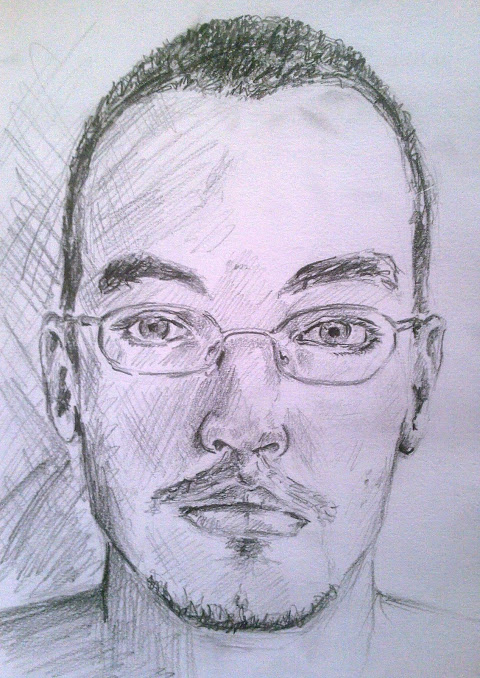
My drawing of a friend


It’s all about me

I can only understand the world through the tools I have been given. This includes my reality, the skills I have and grow, and the way the world interacts with me. Fighting this is not constructive. In understanding myself, I have the greatest ability to contribute. I have to look after the vehicle (physical self) and emotions (how I respond) to participate fully. I will continue to be curious, using the only fully willing ‘model’ to draw. All I need is a mirror. So I will not be afraid of the mirror. I will be a half-hearted fanatic, willing to give generously but fiercely defending the boundaries needed to protect my ability to give sustainably. I will not throw my life away. It is precious. I will also not live meekly. I will take calculated risk. I will let my emotions lead me where indecision would stifle my ability to engage. I will be brave. I will not fear death, I will fear not living.

A friend's drawing of me

Detachment

I will live my life by walking lightly and loving deeply. I work on built-in redundancy. Building resilience, and the ability to cope with whatever the world throws at me. When I face disappointment, I try and do something amazing that I couldn’t have done if that milestone had not happened. This doesn’t make me celebrate and enjoy the ‘dreams that died’ any less. I like to imagine infinite parallel universes in which anything that could have happened, did happen. This is just my opportunity to make the most of this particular random set of events. I try let go of the idea that everything happens for a reason. Reasons are added in hindsight. Detachment helps give life meaning rather than having meaning given to me.

Self-Portrait (2000, 2001 & 2002)

Empathy

I am not a bat. I can not see through the eyes of a bat. It is not possible for me to imagine being someone else. I can only imagine myself in their world. It is not possible for me to let go of my own tools of understanding. It is worth trying. We have wonderful imaginations and can expand our realities by learning the tools of others. By finding a way to connect to and enrich our worlds through others. That is one of my primary motivating factors. Curiosity to expand my ability to see.

Creativity

I do not believe creativity is purely about bringing visions to reality. It is a conversation. A dance. A relationship. I try be an active participant in the world and celebrate what it has to offer. Creativity is cultivating the art of appreciation. Developing a deeper knowledge and mastery of the way different elements engage. Developing a deeper knowledge of how we communicate. Through words, music, drama, colour, line, form, phrasing, tone, silence, contrast, energy and warmth. Diving into creativity is the source of our ability to thrive.

Acceptance

There are 7.4 Billion people on the planet and too many problems, even in my own family, even in my own life, to sort out. It is not my job. I am not able to sort out the worlds problems. There will always be challenges. There will always be pain, sadness, suffering and darkness. That is part of beauty. Developing a life approach where I feel comfortable with the balance between appreciating the world for what it is, and nudging it in a way that adds and sustains value.

Relationships

I believe the heart of understanding is tangible connections. In intimate relationships, we can develop an understanding of things that goes beyond the conscious. That taps into our Tacit Knowledge. I treasure, cultivate, and invest in relationships. I experiment with ways to grow and sustain my connections to others. I learn how people communicate, and how I can best communicate with them. I want to help build communities, and believe that starts with individual connections.

Empowerment

I hate Archy. It drives me bonkers. I believe in empowerment rather than power. I do believe in rules, but as a tool. Rules are simply the consciously understood terms of engagement. If the rule is not followed, it is not really a rule. I try manage this by lowering my expectations of others, but being generous in what I give out. In accepting that other people’s irritation and disappointment is their own to manage. This is counter to my natural emotional wiring which is a ‘Saviour Complex’ and a hatred of ‘getting things wrong’. The only thing I can control and impact is my own emotional world, and my own actions. I take responsibility for that. I will shift my Saviour Complex to an Empowerment Drive.

Monday, November 28, 2016

Advice-Free Listening (Tim)

I guess it’s a bit of a truism that women are usually better listeners than men, and that men tend to give more advice, while women give more sympathy. What’s interesting to me is that there may actually be some factual basis for this.

According to a fair amount of reliable research, women tend to score higher on something called ‘agreeableness’ than men do. Now I can sense a bit of scoffing coming on, so let me explain. Agreeableness is reckoned to be one of the ‘big five’ enduring personality traits, and it is just what you would expect it to be - an aggregate of qualities like kindness, warmth, sympathy, cooperation and so on. And women are slightly better at this stuff than men, as evidenced by the way that they listen.

Now lets turn back to that listening thing. I can’t speak for all the other gents out there, so I’ll have to reveal a bit of myself. If I’m honest, a lot of the time when I’m listening, I’m mostly just planning what to say in response. Let’s say that you just told me about how you missed your fight and got stuck in the airport for ten hours. I have three kinds of responses that I can give. I can be sympathetic, analytical or competitive. Sympathetic is obviously the most agreeable thing to be, so I should listen carefully and then say something along the lines of ‘Ag, shame, hey. That must have been terrible.’ Interestingly, I’m most likely to say this to a woman, or a close family member.

Going Nowhere

But if you’re a dude, or if I’m not feeling especially agreeable, then most of the time while you’re describing your ordeal, I’ll be planning one of the following responses. I can get analytical and ask you tons of detail questions as if your role in the conversation is to get the story straight in my mind. ‘Was it a connecting flight? Why was it delayed? Did you try…?’ Sometimes this involves advice, but really what’s happening here is that I’ve missed the bloody point. It doesn’t matter what you should have done, or the mechanics of how it happened. The other thing that I tend to do, especially when I have a beer in my hand is to start preparing my own story of a travel snafu that rivals yours. This usually happens in group situations and generally leads to a free-for-all story-telling contest.

Stuck at the Airport
Was there wifi? Was there electricity?

Turning someone’s complaint into a story telling contest is not exactly sympathetic, but it has its time and place. In a social setting we can all share our stories and we can all gain a little perspective while bonding with our mates. No trouble there. 

The response that really annoys me though, is getting analytical, and putting the onus on the sympathy seeker to get all the details straight and to somehow justify the sympathy that they want from us. Most of the time, the very act of seeking sympathy is justification enough to give it.

Friday, November 27, 2015

Big On Humanising (with David)

Trev:
Some things are done better at scale. Often + Same Way + Fixed Costs => Bigger is Better. The Industrial Revolution has been smashing poverty. Internal relative poverty in America gets a lot of coverage, but in Global terms, and with respect to absolute poverty, we are making huge strides. A consequence of bigger is that empathy gets stretched. The big boss can no longer have lunch with, and get to know, each new employee. Individual circumstance and fuzziness get replaced with precedent policy. We spend so much time at work, humanising the time we spend in big organisations is an ongoing challenge.

Dave:
For all the strides we can make in combating inequality, for the foreseeable future the biggest determinant of quality of life for most people will still be where they are born and who their parents are. It is more complicated and no more complicated than that. Putting people into organisations that are machines will continue to produce the same results. As the machines we have used over the past years follow the easiest path to money, not the potential of the individual. We need organisations that make people count, not count people as units. We are still some way off.

Trev:
The Labour movement has traditionally been a way of coming together to balance the negotiating power of owners with the solidarity of workers. I suspect the whole way we look at the organisations that decide how people 'count' is about to be turned on its head. Like the music industry. Like media. We need support for individuals outside of companies. Companies are legal 'persons', but they are groups of individuals. Through industrialisation, people may have disappeared inside companies. Perhaps companies are going to be the ones that disappear inside society as the web extends beyond data and into relationships?

Dave:
There is an argument that can be made that the rise of the self employed is a rise in independence. There is also an argument that it is representative of greater influence of organisations as they shift to more flexible resource bases, less willing to provide individuals with long term job security. It is clear that there is a shift towards greater social consciousness, but how this translates into economic reality is the great unknown of the next few years. It is a sharing economy that currently seems to be still pooling money rather than distributing it. For better or worse.

Trev:
It is an interesting transition where we get to redefine the rules. We need to learn from other 'free agents' - musicians, sports stars, actors etc. where they work from project to project. It becomes a case of you hiring your boss and your coach. Instead of recruitment agents being a once off deal, a whole new industry of service providers for flexible employees will need to spring up. I think it is empowering. I think it levels the playing field between the employer and the employee. But the number one rule for a strong negotiating position is not to be desperate, and that is were those with a buffer of capital will always have an advantage. Unless we help provide those buffers for each other.

Dave:
Maybe we won't have a big boss getting around every new starter for lunch, but creating organisations that care about people is still possible. It's no naïve ambition to hope that the contribution organisation make can be richer than just profit or wealth creation - what about community building and social improvement? Start with an assumption of solving for potential mutual benefit for the employees and the organisation, then there are opportunities to reframe profit vs people as a false choice. Indeed profit vs people can be seen as a shallow and unhelpful choice. Profit through and for people is possible.

Trev:
I think we are on the cusp of a redefinition of what a company is. Traditionally we have worked in a company as a means to an end. If you are really lucky, you get the right mix of doing what you love, what you are good at, and what is well remunerated. I think most people end up doing whatever they can. It would be interesting if some companies started springing up where the primary goal is the top bit of Maslow's hierarchy. There are definitely companies that are great at both profit and people. But what happens when people start life hacking as groups? When they get together to work towards non-financial goals as the main thing they do. The world beyond work. Perhaps it isn't that the boss won't have time for lunch. Perhaps it is just that there won't be a boss?

Dave:
Ah, the end of the boss. It's a lovely notion that speaks to our need for autonomy, but there's a reason the Lord of the Flies still has resonance after all this time. We want structure, support and direction as well as space, empowerment and freedom of choice. We want the security of Megacorp with the excitement of Entrepreneur.com. Most organisations exist to work towards financial goals or are heavily focused on them - they serve consumer need, an end intertwined with the worker's intent. Money talks or sleeps - it still dictates purchasing power and our choices. That ain't changing soon.


Trev:
All advice is autobiographical I guess. And I don't like the idea of a boss or of anything being dictated! The rules until you have enough are also different from when enough is a safety net from which you explore. Enough is less than we think. Money talks in a world of material scarcity. Money is worthless in a world of abundance. Until you have the ability to walk away, you have to put up with certain things. I like the idea of a world in which structure, support, direction, space, empowerment, and choice all come from us working together rather than below or above each other. Scale is awesome at solving huge vanilla problems. The flavour comes in the tiny morsels that connect people.

Dave:
There's an important distinction - whether organisations need to lose 'bosses' or need a new generation of bosses who aren't there to dictate, but to support. There is little doubt that at least some of the frustration from people around the '1%' is that they simply aren't in it. Just enough is less than we think, but that still doesn't stop people seeking more. Society may improve if we sought more health, enrichment and happiness - but as long as we see money as a measure of success, the structures that circulate and attract it are worthwhile places to improve conditions.


--- David's first guest post was 'Buffet, Batman & Scorecards' ---
Follow David on Twitter @DDS180

Sunday, November 15, 2015

I Don't Know

I have no idea how to respond to tragedies like we woke up to yesterday other than a deep sickness in my stomach. In January, Boko Haram opened fire on Northern Nigerian villages killing an unknown number of people (estimates range between 100 and 2000). Suicide bombings in Iraq, Yemen, Pakistan and the Philippines killed more than 200 people. In February, more than 90 people were killed in the Cameroon in a burning/shooting incident, again at the hands of Boko Haram, who were responsible for another incident costing 58 lives in March. That month, the Islamic State ended another 137 lives in a mosque in Yemen. April started with the death of more than 147 people in a university in Garissa, Kenya. I am not going to carry on.... Here is a list of terror incidents in 2015.

These incidents seem to bolster whatever someone's opinion was before. Same but stronger. Those in favour of understanding perpetrators will feel we need to work harder to find out why people would do this. Those in favour of force, will feel this is the final justification needed for a full declaration of War. I take some solace in the fact that the reason they are terrorists is because they are losing, but that is small solace. We can do things differently. Perhaps the answer is to do the opposite of what you think? Find out more about the opinions that you are being pushed away from. Don't empower terror by letting it work.

I would like to live in a world where deadly force is never acceptable. Where there is no escape clause for morality. There is no but. No God wills it. No but they did this. Never. The short answer to the question of how we get there is I don't know.


Wednesday, November 04, 2015

Sticky Expectations

'Sticky Wages' is the name for the fact that pay tends to go up, not down. We want our pay to be connected to our performance. Meritocracy and all that jazz. But actually only if the news is good. Would you like it if your boss said, 'Great year, but not as good as last year, so we are going to give you a pay cut.' Bonuses in theory allow the sticky part to be the base, and then anything else is 'extra'. Ummm. Ja. We think in relative terms, and something that excites us or makes us happy often needs to get bigger or more spectacular the next time to have the same effect.

Sticky Expectations

So enter things like redundancy. Being laid off, or not able to find work, must be one of the hardest things that can happen. Particularly if there is a sense of permanence about it. I can't fully empathise, because my close friends, the people am friendly with, and the people who just know my name are almost all employed. That is crazy considering the official unemployment rate in South Africa is 25%. In Britain it is 5%. Amongst the people who's story I know, the figure is probably closer to 0%.

If the rug gets pulled, and it isn't just a case of moaning about your boss not being fair with your raise. Things will get tough. Even if we don't have friends who have experienced running out of money, the idea is pretty frightening. We see poverty. Sometimes we have to just ignore it to be able to function. He harden ourselves. But we (most of the people reading this) don't tend to have to regularly experience cutting back. 

Poverty would be an extreme version. The idea of living on less is also something that is hard. When you are used to certain types of entertainment, driving a certain car, living in a particular area, the idea of cutting back feels daunting. Particularly if it is an independent decision where everyone else in your circle isn't doing the same thing.

By Global Poverty standards, there are virtually no people in the UK living below £10 day. The World Bank set the absolute poverty line at $1.25 (£0.81)/day. In 2013, 1.2 Billion people lived on less than this. Half of them in China and India. The UK is a very wealthy country. Even in a wealthy country, the 2013/2014 HBAI report gave median household income (2 adults) as £23,556. I don't think you are going to feel wealthy earning that. Particularly if you are living in London. You are going to be surrounded by things you can't afford. Things you can't do. In global terms, you have more than enough.


So answering the question 'How much is enough?' is an interesting one. If you are comparing to your last years self. The answer is probably 'more'. If you are reading this, and you are comparing to most other people in the world, the answer is probably 'less than you think'. But only if you can do the mental and emotional acrobatics required to ditch the stickiness.

Sunday, November 01, 2015

A PinkBlue Rainbow (with Yura)

Trev:
Jonathan Haidt wrote a fantastic book called 'The Righteous Mind'. It's subtitle is 'Why Good People are Divided by Politics and Religion'. Quite often when we stumble across something really core to our beliefs where someone we care about disagrees, we choose to walk away. At the very least we don't talk about it. Yura Kaliazin is a good person. We are friends from university. Recently the SCOTUS ruling led to a tribal split on facebook of Rainbow Profiles and PinkBlue profiles. I am interested to understand how we can create a productive, mudsling-free, conversation where there is such a clear line of disagreement.

Yura:
Indeed the SCOTUS ruling has created a large number of heated debates. From my experience, as soon as you say "I do not agree with the ruling, as I believe it's wrong", most of the time you are quickly branded as intolerant, backward hater (or a fanatical religious lunatic), and the conversation stops right there, before any point of view can be put forward. I guess that's one of the reasons why people choose to walk away and not talk about it - why expose yourself to another branding as a "hater" or "lunatic" just for disagreeing on the topic?


Trev:
The normal approach is to look for the barbs of disagreement. Layering discussion with insults. I like the idea of allocating a "Bull Quota", like when you watch a movie. Good movies extend reality to look at things from a different perspective. If they extend too far, or aren't consistent, the suspension of disbelief is snapped. I believe strongly that there is a core of agreement around which we can build allowance for where people can disagree. The interesting thing with the SCOTUS ruling is the hats have changed. For years, the protesters were the Rainbow movement. Now the 'aggrieved' are the PinkBlue. There should be some empathy for the other group?

Yura:
Yet, not many are willing to give empathy to the PinkBlue (predominantly Christian) side, demanding empathy only for their point of view. There is quite a bit of common ground between the two sides, but the devil is in the detail. Should everyone be treated with respect and dignity, no matter which side of the divide you're on? I'm sure both sides agree - yes. Should you keep your mouth shut if you genuinely believe something to be wrong, just because your point of view is "uncool", "unfashionable" or not mainstream? No, I don't believe so.

Trev:
Is a Christmas analogy appropriate? Many of my Christian friends or family talk about wanting to put the 'Christ' back in Christmas. When Christianity was mixed with the State, the State started mingling many secular or cultural holidays into holy days. Christmas was one. As society has become more secular, Christians sometimes feel the cross-cultural family day Christmas has become is no longer their religious day. Marriage was also around before Christianity made it very core to their faith. The State then incorporated and regulated it. Is it a matter of religious ceremony and holiness? If there was a word to celebrate a PinkBlue marriage, and a day to celebrate the birth of Christ, would that allow the respect and dignity you talk of?

Yura:
Respect and dignity I was talking of when having a discussion or argument on the topic (like we're having now). As for Christmas, I am a Christian, and to us, Christmas is and will always be Christ's Birthday, regardless of State, trends or fashion. It's just increasingly easy to get distracted from what Christmas really means, even to us Christians. As for marriage - "is it a matter of religious ceremony and holiness" - the former yes, to a lot of people, but the latter is to me the core of the matter and disagreement the "fundamentalist" Christians, like me J, and the Rainbow movement.

Trev:
I am not religious, but I buy into the idea of keeping objects and ideas holy. Something as simple as some religious people wrapping books in a special cloth, only opened on a specific day, in a specific way, with specific people. I also like the idea of giving people space to do things that are special to them with people that matter to them. Where I get confused is why we would want the state to be involved in this anyway? The SCOTUS ruling, to my knowledge, didn't stop anyone from doing anything. There are Christians who accept marriages that aren't PinkBlue. There are those that don't. It is still possible for "fundamentalist" Christians to have their holy ceremony of PinkBlue marriage, and to celebrate Christmas as the birth of Christ. Hopefully, when the dust settles, we'll realise we aren't fighting over anything since everyone can then do what they believe is right, as long as they don't interfere with others?

Yura:
I guess the very last piece of your last sentence is the catch. Problems arise when Christian pastors, who hold firm to their beliefs, are forced to partake in Rainbow ceremonies, and being taken to court if they refuse. Is this not enforcing one's beliefs upon someone else by brute force, just because the State has given you the big stick to do so? The strong impression that I have built up over the last few years is that Christians are always expected to be tolerant to everyone and everything (it seems it is in fact increasingly demanded of them), often to the detriment of their own beliefs. Yet non-Christians seem to reserve the right not to tolerate Christians and the Gospel (and many to bitterly mock them at every opportunity). Double standards at play? And, as I said before, if you see someone you care about do something that you strongly believe is wrong, you would speak up - even though it might be interpreted as interference...

Trev:
I agree that enforcement is the heart of the problem. Tolerance does require people to genuinely accept and allow alternative views which don't infringe their rights. It gets tricky when jobs require that tolerance to need action that doesn't harm you, but appears to indicate you agree with views you don't. Silence can appear to be agreement. Speaking up also means judgement, and most people recoil at being told they are evil/bad/wrong/sinful. All those words are very loaded. Even 'agreeing to disagree' creates walls. My view is the law should keep out of it and big sticks shouldn't stop rainbows or enforce them. On a personal level, choosing when to 'interfere' is more problematic. Both sides need to care about each other first and earn the invitation to interfere.

Yura:
I guess it is a bit of a Catch 22 - stay silent and people think you agree, speak up, and get branded... Agree - no one likes to hear unflattering things about themselves, but again, to just always keep quiet? And also think it has to do with how you say it - evil - not you yourself, bad - no necessarily, wrong - yes, sinful - yes, we all are, in one way or another. I do agree that there needs to be some level of trust or relationship before you can speak up - no-one is likely to take a total stranger seriously. I am a numbers guy, I don't speak or write well, so as a wrap-up, I'll let the professionals do the talking, via these two "links" - Roman 1 22-32 and http://www.tosavealife.com/10-life-giving-truths-for-the-gay-christian/

Friday, October 09, 2015

Encouraging Empathy (with Tim)

Tim:
I want to start off with the idea of empathy. Roughly speaking, empathy is the ability to read the emotions of others, combined with the ability to imagine what they are thinking or feeling. Unfortunately, empathy is in decline in our society. A series of studies from 1979 to 2008 found that there has been a significant decline in empathy amongst young people, with the sharpest drop after 2000. Similarly, another study in 2010 has found that as people's socioeconomic situation improves, their ability to judge the emotions of others, their 'empathetic ability', declines. Is this something we should care about?

Trev:
I would love to see those studies. They seem different to my experience of a world with more connections. You would think that once you have put out the fires (have enough to eat, a roof, clothes, and your family are safe), you have more capacity for empathy. A world of scarcity should cause you to fight for limited resources. A world of abundance should be a place where we should care more about how we are connected to others. There are limits on empathy, I can't 'think like a bat', but I do think we should care about learning to try and listen, and feel, from different perspectives.

Tim:
Just like you, I have read and been deeply influence by Steven Pinker's 'The Better Angels of Our Nature'. So, I agree with the idea that once our basic needs are met, and once we have the cognitive space to take the view of others, then we do become more compassionate. However, I think that's only true up to a point. I think that we may now be seeing the reverse of this trend in some places. And the Internet, instead of bringing us closer, is actually alienating us. I think that social media like Facebook actually reinforce unpleasant tendencies like narcissism and therefore reduce empathy.


Trev:
Gossip is a powerful way of evolving new etiquette when it comes to new technology. I was once sitting around a pool with 13 laughing people as someone's narcissistic facebook post was read aloud. Apparently an email list with this person's posts had gained quite a following. Banter about arbitrary pictures of food, and false modesty postvertisements of 'I  have been so humbled by this amazing thing I have achieved' do make people think twice. I think we improve. Think of how many people now turn off their cellphones at dinner, or put them on silent. We can't blame technology. Perhaps the reduced empathy is a messy middle step because we are engaging with more people who are different from us? It is easy to empathise with someone with your same worldview. 

Tim:
Technology has promised us a lot more than it has delivered in terms of social connections. For example, in the field of language teaching there has been great excitement about computer assisted language learning ever since the nineties, and yet each new innovation soon gives way to learner fatigue, and time and again we see that there is no substitute for a real live teacher who can build rapport and motivate students. It's the same with any communication which is mediated by technology. Sooner or later, we all crave the intimacy of face-to-face communication. I would say that it's time for a return to more empathic human relationships where we look one another in the eye, and learn to read each other's emotions again.

Trev:
I use technology as a catalyst for human interaction. I would certainly rather by having this conversation with you over a beer. It would mean we could spend a few minutes talking about how useless my brother is. I don't think we can blame technology for our emotional intelligence deficiencies. Technology can certainly highlight them! Hopefully that gives us a chance to create boundaries and use the tools rather than letting them use us. Growing up, we had a rule that you didn't phone anyone after 8:30pm. It was rude. That rule is gone. Social media has led me to meeting up with people I wouldn't have known were there. As with music, digitisation hasn't replaced live performance. There is something magical about personal interaction.

Tim:
When I found out that Dianne Kohler-Barnard from the DA had shared a Facebook post which glorified PW Botha, I was reminded that many white South Africans really don't have any empathy for the harm caused by Apartheid. I don't know if you've read 'Country of My Skull' by Antjie Krog, but I personally think that it should be compulsory reading for all white South Africans, because it forces us to look at the brutal and tragic waste of life exposed by the Truth & Reconciliation Commission. It's such a gut wrenching and empathic work that it almost destroyed Antjie Krog while she was writing it. That's the kind of visceral and deeply human storytelling that we need to restore our empathy in a world that celebrates style over substance.


Trev:
I haven't read it yet, and will consider it compulsory, and grant you the right to strike down upon me with great vengeance and furious anger if I haven't read it post-haste. I did read 'A Man of Good Hope' by Jonny Steinberg which helped personify the ugliness that is Xenophobia. Stories have a wonderful ability to build empathy. I don't think we are capable of seeing the world from each other's perspective, but we can learn how many connections we share. We can listen. Whether by coming together face-to-face and creating those connections, or hearing about the web of stories that make us up. Many of those stories have common ingredients.


Tim:
'To Kill a Mockingbird' is a classic in terms of building empathy for those who are not like us, and maybe the most memorable quote from the book is: "You never really understand a person until you consider things from his point of view... until you climb into his skin and walk around in it." I guest that's what I'm thinking of when I talk about empathy and compassion. I aspire to that ideal, but it takes a lot of courage. It's a risky business giving up your own perspective for a minute, and it's a risky business exposing yourself to other people's pain, even for a short while.


===========

Tim Casteling teaches English in Seoul, South Korea. 'Old Friends' was his first guest post.
Don't follow him on Social Media, rather track him down and have a chat face-to-face. He likes that.

Sunday, August 16, 2015

Benefit of Doubt

Life is more inspiring and fulfilling if you give people the benefit of the doubt. When someone does something that irritates, exasperates, hurts or confuses us, the temptation is to think their intentions are based on our knowledge. How could they possibly have done that if they are a good/ intelligent/ caring person? We have limited attention and memories. We have conflicting goals and inconsistent beliefs. Very seldom are people's intentions malicious. Like watching a movie, it helps to suspend disbelief. People make mistakes, but it is often not for the reasons we think. We can cut each other some slack.

Thursday, July 23, 2015

Outstoried Stories

If you have ever had the privilege of popping over to the opposite side of the world, you will have felt the joys of jet lag. The body being forced to adjust quickly to a rhythm it doesn't recognise. You don't need a long haul flight or to be surrounded by people who give nicknames to everything to understand this. Most people who work Monday to Friday enter a similar sort of rhythm. My big city rhythm involved getting up early enough to avoid a sardine can commute, and working till things calmed down to leave. I would get home just in time for an 8pm Yoga class, grab something light to eat afterwards and soon be off in dreamland. Next morning I would lock and reload. Every now and then there was the good old feeling of Groundhog day. Getting ready in the morning can blur into a series of toothpaste being squeezed onto a toothbrush that really should be replaced. 


We can get into colliding rhythms with people doing different things. Interpersonal jetlag. When you are sitting in a coffee shop all relaxed and the couple next to you are tearing 51 shades of violet out of each other, it can be tough to hum along to Jack Johnson. I think it is part of our fight or flight tendency that we adjust to the rhythm of most discontent. We look for fires to put out if they are around us before we relax.

One form of adjusting rhythms is the debrief. When I have seen something that grates me the wrong way, I feel the urge to tell someone. When I have had a bad day. When I have had a good day. By telling someone, the rhythm spreads and we aren't facing things alone. We can then move on. When people are working, this adjustment often takes the form of a 'post work debrief'. An answer to the question, 'how was your day?'.

If you, like me, have ever had a family member, friend, housemate or romantic partner who was a medic - your debriefs may be more tentative. I fast learnt that my problems never involved someone dying. My stories could always be outstoried. The advantage of perspective.

Once we are into a rhythm, once groundhog day sets in, it is easy to forget that there is a whole different world out there. South Africans, for example, may look at foreigners in the country and think they came believing the grass was greener on the other side only to get a horrible surprise. Umm, no. Do some wiki-walking about the wars in the Congo which didn't get much press. Read 'A Man of Good Hope' about one of the Somali refugees who made his way to Cape Town before the Xenophobic attacks. The grass is greener. What drives someone to uproot and search for hope? Not realising your story can be outstoried is not a uniquely South African issue. We all tend to focus on our local problems and look after 'our own'.


As a lighter example, I enjoy going to Conferences even though the presentations are normally mostly awful. They help pull me out of whatever I am focussing on and connect with other people doing other things. I enjoy watching those YouTube clips showing how small the earth is relative to other planets. How 100,000 years on earth is a relatively short blip in the story of life on earth.

Rhythm helps us focus. Disruption gives perspective.

Saturday, July 18, 2015

Balanced Scorecards

Being able to quantify things makes them much easier to manage. You can compare them. You can say which ones you prefer. Which ones are more important? You can see if you are improving. You can prioritise. An ordered world helps you figure out what matters. What causes what? Then you can do more of the things that cause the results that you want. Boom. The world makes sense.

By quantifying things, you can use equations to create models of how the world works (aX = Y + e). If I have ‘a’ many Xs, I will get a Y plus some noise, the (e)rror. So, almost Y. Regression models let you build up complicated equations that explain things. Almost. Simple models let you test whether different things (an action and an outcome) are connected. They help the world make sense. You can plan.

The desire to quantify can be very powerful. It assumes there is an underlying order that we just need to understand, and we can bend things to our will. An underlying order plus some noise. Noise is the bit that makes results differ from what we expect. However we explain the world, it is more complicated than that.

There lies the problem. In reality, whenever we test something we are only seeing the results that occurs with that very specific set of conditions. I might prefer Apples to Oranges. But if it is half time at a rugby match I prefer Oranges. I might prefer waking up early to miss a horrible sardine style sweaty commute, but it depends how I feel at the exact moment my alarm goes. aX only equals Yish if there are no oranges, sardines, rugby etc. Then only if I feel like it. It depends.

A popular management tool in the workplace is the Balanced Scorecard. It takes all the aspects of your job and breaks them down into quantifiable targets, then assigns weights to each of the targets depending on their importance. Slowly but surely you add more and more things that are important, until even the very important thing end up getting weights of 10%. Something like getting along with your colleagues may get just a 1% weighting. If you don’t get on with your colleagues, the other 99% may not matter at all.

Balance Scorecards and Rock Balancing

Balanced Scorecards give the illusion of manageability. In my experience the best managers I have come across are able to dispense with these tools. The problem is this is not scalable. The magic ingredients they added were time and trust. The very best manager I ever had wasn't even my manager. She managed a team alongside me, and we worked together. But I learnt more from her than from anyone else about how to get the best out of people. Her super power was listening, the occasional challenging question, a sense of humour and a genuine sense of empathy. I wasn't a cog in her eyes.

Knowledge comes from the front lines. It comes from a deep understanding of the specific set of conditions. It comes from the qualitative stuff that glues the quantitative stuff together. It comes from the stuff you can't quantify. The stuff you can't communicate. The main lesson I learnt from her is that the best way to manage is not for people to work for you, it is for them to work with you. Balanced Scorecards are an attempt to allow for distance between where decisions are made and where they are implemented. The truth may be that you can't do that.


It’s more complicated than that. Conditions matter. It’s simpler than that. Trust people.

Monday, July 13, 2015

Buffett Buffet

Conversations, social media, blogs and banter don't go through the same rigorous editing as most professional media outlets or corporates. Your Mom likely stops correcting your grammar at some point. Maybe because you have gotten better. Maybe because she has given up. We get to relax, and if we are surrounded by close friends - we can let our guard down. At times we need this. A friend shared a wonderful article about 'holding space' for people when they are going through a tough time. Removing all the editing and looking for the thing that matters. My Dad often reminds me to listen for what people are feeling, not what they are saying. We can do that with friends, not when we are releasing 'professional' articles.

Writing professionally can be death by a thousand cuts/edits. You can go in circles as the meaning of each phrase is debated. Done badly, the voice of the author can be lost. Your voice includes all those little mishaps that give you character. Remove that, remove your style, and you remove the empathy that makes the facts worth listening to. Removing typos doesn't kill the voice though, it stops distraction. Like wearing the appropriate clothes makes what you are saying the topic of conversation rather than what you look like. Two typos that catch me out often are there/their and Buffet/Buffett. When I publish my blog, even after a spell check, and reading through it a few times I often won't see those errors. Having someone else read the blog first would be great. New eyes see our errors since we read what we mean, not what we have written. It also adds friction though. Imagine you had someone who listened to you and then corrected every line. A translator of sorts, even when you were speaking the same language as the person listening. No thanks. I will keep my mistakes (and correct them as soon as someone points them out).


Warren Buffett 'is not an all you can eat food selection' Mike Browne

When you are actually speaking to someone, you have the advantage of body language. You are reading them even as they are listening to you. You can adjust, emphasise, and correct. The way you say something also matters. An early colleague (half) jokingly told me that if you want someone to believe you say something with confidence and to two decimal places. 94.67% of statistics are made up anyway.

A big part of professional writing is fact checking. If you publish something that is wrong, it makes people start to question everything else you say. Teams of number people will go through calculations again and again. A Maker-Checker process where multiple eyes look at the same thing. In real life, most of our conversations are not fact checked. They are based on our experiences and particularly our experiences with enough emotional resonance to become stories. We will tell people if we have been mugged. We will tell people if someone has be racist, sexist, homophobic, xenophobic or any of those other things that get our blood boiling. We don't really repeat things that were fine. That were nice. That were okay. Facts can get in the way of a good story.

I don't think we would be better off if everything we said in informal settings was fact checked before we said it. I don't fact check guest posts. I put facts I believe in my posts. I am always fact checking myself, but part of the way I do that is by writing blog posts. I hope that the best way to correct errors is to make them in public. The real errors are the ones where I don't know are wrong. The danger is obviously that if the incorrect facts make good stories, they can spread fast. They can inflame. The incentives may not be there for the truth to spread.

That's when perhaps it best to follow my Dad's advice. Listen to what the writer is feeling. Allow a bull quota for the things that get our blood boiling. Then help correct errors and create a better story.