Showing posts with label Meaning. Show all posts

Sunday, April 05, 2026

The World Exceeds Us

The deeper philosophical challenge of AI is not merely that it may become more capable than us in many domains. It is that it makes us feel, in a newly intimate way, that we live inside a world that exceeds us.

That feeling is not new. Human beings have always lived among things larger than themselves. Nature exceeds us. Time exceeds us. Death exceeds us. Society exceeds us. History exceeds us. Chance exceeds us. For many people, God exceeds us.

But AI introduces a different kind of excess. It is not wild like weather or distant like the universe. It is closer. It speaks our languages. It works inside our symbols. It enters the territory we most associated with being distinctly human: thought, language, creativity, strategy, memory, analysis, even the imitation of care.

That is why the unease runs so deep. AI does not only threaten jobs, industries, or business models. It unsettles a deeper assumption many of us carried: that the world of meaning was still scaled to the human mind. However vast reality might be, language, interpretation, and thought still felt, in some final sense, like ours.

Now even that feels unstable.

So I do not think the AI question can be answered only with policy, economics, or productivity gains. Those matter. But beneath them sits something more existential. What does it mean to live well in a world where intelligence itself is no longer scarce, singular, or fully human? What does agency mean when cognition is increasingly distributed? What does authorship mean when the line between originator, editor, curator, and machine becomes blurred? What remains deeply ours when so much becomes replicable?

In response, I find myself drawn not to philosophies built on certainty, but to frameworks that begin with uncertainty and remain standing anyway.

My search has been for a philosophical framework that does not fall apart when one of its key claims turns out not to be true. Too many systems seem strong only while their central premise holds. They rely on a stable metaphysics, a fixed hierarchy, a final truth claim, or a clean theory of progress. But reality is rarely so polite. Randomness intrudes. Ambiguity persists. Infinity opens beneath our feet.

And yet there is something oddly grounding in that. These are not deficiencies in the world. They are its texture. They do not promise closure. They do not collapse when life refuses resolution. They make room for creativity because they make room for unfinishedness. They let us build without pretending we have arrived.

This matters because the information is not always in the solution. Often it is in the pressure that shaped it. In the trade-offs. In the contest. In the adaptation. In the imperfection that reveals where theory met reality and reality pushed back.

There are also many things of immense value that have no final solution at all. Love has no final solution. Parenting has no final solution. Trust has no final solution. Meaning has no final solution. Coordination has no final solution.

These are not problems to be solved once and for all. They are conditions to be navigated repeatedly.

That is where an evolutionary lens helps. In Red Queen worlds, the point is not arrival. The point is continued adaptation. Survival belongs not to what reaches perfection, but to what stays responsive.

Progress does not eliminate problems. It changes them. Even if marginal progress dwarfs historic suffering, new problems emerge. Better knowledge solves some constraints only to open new frontiers of difficulty. The dream of a world with no problems is not optimism. It is a category mistake.

But there is a danger here too. Process matters. Practice matters. Embodiment matters. But process can also become a hiding place. You can become so devoted to craft, routine, learning, or self-development that you quietly avoid contact with consequence. You can hide from winning and losing inside the language of process.

Reality, however, keeps score.

That is why I think the wrestle, the fight, the flow lies in the unobtainable. Not in fantasies of final mastery, but in repeated engagement with what resists final capture. The point is not to pretend there is no scoreboard. The point is to accept that the scoreboard exists in games that do not end.

This is also where flow becomes useful. The best moments of human experience are often not those of full control, but of deep absorption at the edge of challenge and skill. Flow is not closure. It is participation. It is not the fantasy of having solved life, but the felt experience of being fully engaged in something meaningful, difficult, and alive.

That supports the intuition that a good life is not built on final certainty, but on responsive involvement.

Positive psychology adds something too, though in a more practical register. A worthwhile philosophy cannot only ask what is true in the abstract. It must also help filter for what helps a life go well. Pleasure matters, but it is thin on its own. Engagement matters. Meaning matters. Relationships matter. Strengths matter.

A philosophy of participation must help distinguish between what merely feels good in the moment and what deepens aliveness over time.

But none of this is lived by abstract minds. It is lived by nervous systems.

That is where emotional and social intelligence matter. A world that exceeds me is not only a philosophical problem. It is an emotional event. It triggers fear, envy, shame, excitement, defensiveness, awe, status anxiety, and disorientation. AI does not only challenge our theories. It challenges our self-concept. It presses on our sense of worth, distinctiveness, and place.

So a philosophy of participation must include self-awareness. It must ask not only what is true, but what is being activated in me? Am I responding to reality, or defending identity? Under pressure, people narrow. We become reactive. We lose subtlety. We defend image rather than truth.

Any framework meant to guide action in ambiguity must include the capacity to notice emotion before it hardens into ideology, panic, or domination.

Self-regulation matters just as much. It is one thing to admire uncertainty in theory. It is another to remain steady enough to act well inside it.

And because human life is irreducibly social, social intelligence matters too. Participation is not merely about me and the world. It is about me with others inside the world. Social intelligence is the ability to sense what is happening between people: who feels threatened, where trust is present or absent, what is unsaid, what emotions are spreading through the room, the marriage, the team, the institution.

That matters because coordination failures are often not failures of logic. They are failures of attunement. People can share data and still miss one another. They can agree on the facts and still corrode trust. They can build brilliant systems and poison the social field in which those systems must operate.

So a philosophy of relationship needs more than metaphysics. It needs emotional regulation, social attunement, and the capacity for repair.

And it needs to learn from systems that have been practising coordination far longer than we have. Nature’s intelligence is not a single mind. It is distributed intelligence: biodiversity, redundancy, excess variation, experimentation, seeming wastefulness that turns out to be resilience. Nature does not optimise for elegance alone. It builds through abundance, overlap, and contingency. What looks redundant in stable conditions becomes essential under pressure.

A system with no redundancy is efficient right up to failure.

That observation matters far beyond ecology. It matters in finance, relationships, politics, organisations, and inner life. Cash buffers matter. Friendships matter. Broad skills matter. Slack matters. Emotional range matters. A family, company, or civilisation that optimises away all redundancy may look smart in calm conditions and prove fragile under stress.

This is where reversibility becomes such a useful filter. Not all decisions deserve the same weight. In a world of ambiguity, you do not need perfect certainty for every move. You need to know which choices can be revisited, repaired, or abandoned, and which ones lock in consequences.

Good judgement is not only about being right. It is about preserving room to adapt.

Many people stay stuck because they treat every choice as final. Intelligent action often comes from moving early where the cost of learning is low, and slowing down where consequences are harder to unwind.

This brings me back to the philosophical thread underneath my AI concerns. Perhaps what I am looking for is not a philosophy of certainty, but a philosophy of orientation. Not a system that promises final answers, but one that helps us participate well in a reality that exceeds us.

A philosophy of coordination, relationship, and participation.

For decisions, it would help filter not for perfect certainty, but for reversibility, resilience, relational cost, and long-term generativity. For relationships, it would privilege mutuality, honesty, repair, and trust. For ideas, it would ask not merely whether they sound elegant in theory, but whether they remain useful when life gets messy.

AI intensifies the need for this kind of philosophy because it presses directly on the old human fantasy of centrality. If my framework depends on me being uniquely special, irreplaceable, fully in control, or the sole meaningful centre of thought, then AI destabilises me at the roots. But if my framework is already built around participation in a world larger than me, then AI is not a total refutation. It is an escalation.

Losing centrality is painful. But it need not mean losing significance.

You do not need to be the centre of everything to matter deeply within it.

Perhaps maturity is the shift from centrality to participation, from control to coordination, from dominance to relationship. That, to me, is the existential crisis of AI. Not merely that it may exceed us, but that it makes thought itself feel less exclusively ours.

A world that exceeds me used to mean nature, time, death. Now it includes intelligence.

So the question shifts.

Not: how do I remain on top?

But: how do I remain human, agentic, creative, and in good relationship inside systems of intelligence that exceed me?

That feels closer to the real question.

And it leads to the practical ones.

What should I do next?

Do the next thing that is alive, honest, and reversible enough to learn from.

What should I build towards?

A life with more coherence, more optionality, and better forms of participation.

Why?

Because life is not asking for a final theory. It is asking for good participation.

There is no solution.

But that need not be despair.

It may be the beginning of a more durable kind of hope. Not hope that the game will end, or that uncertainty will disappear, but hope that we can learn how to participate well. That we can become the sort of beings who do not collapse when the world exceeds us. That creativity, relationship, and wisdom are still possible, not in spite of unfinishedness, but because of it.


Monday, May 24, 2021

Future Uncertainty

We speak in chunks. A single word can connect to a world of shared meaning, or none at all. There is too much for us to understand, so we pick areas and hopefully have overlaps that allow the important bits to spread. Risk is a chunky word. When choosing a path to financial security, risk was the overlap I chose to study. Actuarial Science is a framework for making financial sense of future uncertainty. Primarily through statistical and business understanding of the past using large data sets. It takes advantage of the law of large numbers. There are different forms of uncertainty and risk. For most people, risk normally just means something going wrong. The study of risk goes wider than that. Looking at complexity, ambiguity, and the randomness of the world, and trying to find within that, “is there anything that we can rely on?”. When you look at individual instances of something, life can feel like a spin of the coin or roll of the dice. But if they are fair, there are 6 sides of a dice and 2 sides of a coin. Actuarial Science is partly the study of, and attempt to weather the storms of, “the underlying” rather than the specific result. A consideration for the variety of outcomes that is a form of “there, but for the grace of God, go I”. 


Thursday, March 25, 2021

Rippling Consequences

Westworld explores how others might have a better understanding of you than yourself. The chance, if we aren’t paying attention, that other people can see what we can’t see if they are detached and observant. In “Sapiens” & “Homo Deus”, Yuval Harari questions how willing we will be to work with artificial intelligence and things that watch us. Virginia Postrel talks about tacit knowledge in “The Future and Its Enemies”. Stuff we understand without knowing we understand. The driving force behind Adam Smith’s invisible hand. You don't need central decision-makers making complex decisions. You want to drive choice down to where the knowledge lies. We don't necessarily understand ourselves, but we are still the best place to make our decisions. Attention doesn’t scale. Someone understanding us better than we understand ourselves relies on deep listening and care. Local markets with ultra-local decision-making empowers people to make decisions. Information feeds up through the paths that people choose. Through the impact of their actions. Rippling consequences of meaning creation. It doesn't matter if we don't understand this in watered-down averages and stereotypes. It does matter to the intimate relationships that wrestle with understanding. 


Wednesday, November 11, 2020

Adapt

Investment Analysts build models of businesses to help understand complexity. The point of the model is not to be correct or not. You know in advance that you cannot have an accurate map of the future.

Nature does not subscribe to the simple cause and effect story that we use to try control the world. The point of any of the models in our toolbox is simply to help us make sense of things in a human way. To add a story. To add meaning. Like other tools we have made up – countries, words, money, political parties, ideologies, agreements. They sit on top of reality to process our controlled hallucination.

Personal Financial Plans are similar. They are not fixed in stone. They are not correct or wrong. They are an ongoing conversation. The only thing you can truly plan for is things not going according to plan. A good plan starts with a picture of where you are. Then builds towards capacity to adapt, adjust, and accommodate. As you change. As you live. As you add meaning.


Friday, November 06, 2020

Creating a Why

Money and words are a form of communication. A way to hear stories. You can reflect on and learn through other people’s stories. Your reflection will change as you change. Part of my story is Apartheid in South Africa. I cannot let go of History. I refuse to let go of History. Because it is such an important part of understanding. We carry all this knowledge with us. Some written, some aural, some in the way we dance, the way we make our art, the way we build community. Part of being human is this beautiful, deep, painful, glorious, connection to everything. The future, the past, and other people’s now. That source of understanding gives us a powerful view of the why of why we make our decisions. I believe that life does not have meaning. We give it meaning. We create meaning. Books like Victor Frankl’s “Man’s Search for Meaning” and David Duncan’s “The River Why”. See what your values are. See what is important to you. Then create a bolder life.


Wednesday, May 06, 2020

Creating Meaning


How you define words matters. What do you mean? Meaning is revealed over time through what we pay attention to, and what relevance we attach. Through the meaning we create. The actions we take. I am a Commitmentphobe, or a Commitmentphile depending on how you define commitment. I believe in Broad Framing. That you need to pause, step back, and reflect on decisions in context. That everything is connected. I love dogs. I don’t own a dog. A dog is a commitment. Affecting holiday choices, times you wake up, cleanliness of the home, and various other things. They also give great cuddles, and I love cuddles. My preference for commitment is to things that I can keep the commitment to. Not in the moment. Not outside of my context. I believe in the long term. That small moments compound. Fully committed to this moment. But also, in how it is connected to the next. And the next. Choosing what we pay attention to. Remembering the connections. Building meaning over time. That’s what I mean by commitment.


Little Me and my Milligan

Wednesday, October 03, 2018

Push and Pull

I don't believe everything happens for a reason (pulled). I don't believe everything happens because of something (pushed). I believe the majority of things happen because things happen. I find that comforting. There is no ill-will involved. We are the positive-will involved. The 'push and pull' of it gets added afterwards by us. We create the meaning. The story. We connect the dots in a way that makes us feel empowered. We cope. We make the best of situations. Even successes close doors. When something goes well, it means there are other things you can't do. The beauty of our imaginations and resilience is we get to decide our story. We get to choose what matters to us, and what doesn't. Then take the next step.

Tuesday, July 24, 2018

Profitability and Creativity

'The best way to make a small fortune is to start with a small one.' Someone's visible signs of success are not necessarily a good indicator of the underlying changes. The direction. The growth. Creativity is complicated, ambiguous and confusing. It can't always be counted. It needs a deep understanding of needs and wants. What it means to be human. What it means to be alive. 'Forward' steps face random changes and can only be known in advance if the thing has been done before. Known steps aren't creativity. Underneath everything, creativity is our contribution. It is our creation of meaning. Our purpose. It determines whether we are consumers or custodians. Whether our activity actually takes more out than it puts in. Whether our winning requires someone else's losing. Taking versus making. Creativity determines the why.


Wednesday, August 16, 2017

Soul

I love stories. They breath life into objects, facts and things by creating a way for us to relate to them. Through comparison and contrast, they tease out meaning. They create meaning. I believe we have one soul in the same way as we have one story. Our separate stories are an illusion created to allow us to focus. Vedantic philosophy calls this illusion Maya. The same dots connected in different ways by different people to come up with infinite ways of seeing. We identify with the separate stories, but one day that identity will fade to dust and all that will be left is the story. Through the lingering connections to the other stories we helped build. Through the lingering connection to our shared story. Our shared soul.


Sunday, July 09, 2017

Pointless


There is a story of Alexander the Great coming across a Yogi on the banks of the River Indus, sitting quietly. Alexander asked what the Yogi was doing, and he replied, "Experiencing doing nothing". The Yogi asked Alexander what he was doing, and he replied, "Conquering the world". Both men smiled at what the other was doing, and thought "Pointless, what a wasted life". 'Wu Wei' is a concept in Taoism that could be seen to combine the two. It means 'action through inaction'. When action comes through an effortless engagement, without any attempt to force or control.


Saturday, December 31, 2016

Building Buffers

Buffers protect what is precious to us. What we care about can be fragile under repetitive strain. That is seldom the best time for fixing. Challenges usually easy to deal with get amplified. Bumps become mountains. Buffers create a cushion of why before dealing with the how. Buffers are deep breaths.  Quality Time and Quantity Time are close because they create space for each other. We may remember the highs and lows, but the moments in between hold it all together. You can't be there for the moments that count without being a soft presence for the moments in between. Gaps, pauses and spaces provide cushions for meaning. 

Pauses, Gaps, Calm

Tuesday, September 06, 2016

Essentialists

People are essentialists. We believe that there is something core at the heart of things and people that make them what they are. Beneath the simple characteristics there is an essence. A story. That story matters deeply. Change the story and you change how we see the thing even if nothing physical or biological changes. Holding a baseball we believe Babe Ruth hit for a home run is different from holding an identical baseball that he didn't. Same ball. Hearing Roger Federer tell his story is different from hearing Roger Federer's life story. Same story. The connection between the thing, the story, and us is what creates our reality.

The story gives the ball its value

Tuesday, August 16, 2016

The Perfect Game

I love Rugby. Mostly I hate it. It has the ability to pull all the joy out of my world. A Test Match can feel like I am having to sit through detention at school. When the Springboks play badly. When they can't seem to catch the ball. When they seem dominant, and still lose. When we have to go through cycles of politics where it stops acting as a tool to bring us together, and becomes a tool of division.


Then there are magic moments. Often Test Matches between the Springboks and the All Blacks. Everything clicks. The game is a thing of beauty. If I am watching with friends, moments are created which we never forget. Unrestrained joy and man hugs.


Plans should be like Rugby. The rules are never completely right. We moan. We sulk through games. We can't plan what we would like to happen. We blame the ref. Then we come back and watch again. Every now and then there are moments of magic, but mostly it is about the experience of sharing the game with friends. Creating meaning.


We can't control the world. We can't even understand the world. It is hard to see a pathway to our dreams. Instead of controlling, we can agree on a set of rules. Randomly pick a shape of a ball. Draw lines on some grass. Choose positions. Put a bunch of things that don't mean anything together. Play. We can tweak the rules as we go along, believing that one day we will come across the perfect game.


There is no perfect game.
Play. Watch. Support.

Friday, November 27, 2015

More Than Everything

Contradictory things are sometimes true. Preferences aren't always consistent. What we want is fuzzy. The Pale Blue Dot picture of earth was taken from more than 4 billion miles away. All we have done in less than a pixel. What we do doesn't matter. And yet, what we do is the only thing that matters. 

'All of human history has happened on that tiny pixel' Carl Sagan

The ability to take what you do very seriously, while at the same time having perspective seems contradictory. I am at my very worst when I am desperate. From a logical perspective, you never want to be desperate. If you can't walk away from something, there is nothing you won't give to have it. Not because it is worth more than everything else. Nothing is ever worth more than everything else. But logic stops when you are desperate. You don't sit back and in a calm fashion figure out what everything is worth to you, what you prefer, and make a choice.

The heart of addiction. Momentary desperation which halts the ability to walk away. An intoxication that destroys your ability to value anything else. Nothing, however true, however important, is worth sucking all your energy away. Holding back allows you to give more. Allowing time, allows you to give more. Laughing. Listening. Relaxing. Space, allows you to give more.

Nothing matters more than everything. Which is why everything matters.

Monday, October 26, 2015

Escape Hatch Problem

I have always felt very uncomfortable when I don't feel understood. When thoughts are bubbling round my head, I am able to recognised that they are only partially formed. Some will die. Some will survive. They will all change. I used to think honesty was about opening your mouth and letting those thoughts run free before they were ready. I really struggled with this. Often my ideas change as they are leaving my mouth. Often they change as I read the body language of the person who is hearing them. Speaking is one way of giving ideas life. Of testing them out away from the relative safety of our minds. 

Unless you feel like the person listening is on your side, it can feel like each utterance, each action, even each thought, is a test. Will the person stay? Rich and I talked about the 'escape hatch problem'. The world is so big now, and we are so mobile, that as soon as things become uncomfortable, we can move on. We don't have to fight with ideas that conflict with ours. We don't have to sit with things we don't like that aren't going to change. We always feel like the world is so big, we just have to find our own individual Utopia.


My Utopia hasn't solved all its problems. It still has death, disease, fighting, and disagreement. It still has people who do things completely differently to me. It still has people I don't understand. The thing that defines my Utopia is that issues don't get more mental space than they deserve. Suffering is normalised. If a pain is Chronic, it is recognised. The sufferer receives empathy. The sufferer is not defined by their Chronic pain. They are able to participate and enjoy the other things life has to offer. My Utopia is defined by improved communication and an expanded definition of who we are.

I believe we are made up of connections. These connections are formed every time we interact with the world. What we do matters. What we touch. What we taste. What we say. The more we connect, the more meaning we create, and that is who we are. We are the meaning. I believe the more we are able to provide space for people to communicate without angst that connections will be severed, the more we will move towards my idea of Utopia.

Honesty isn't about the words. Honesty is space and time.

Friday, October 23, 2015

Transitioning Potential (with Malcolm)

Trev:
We should retire the idea of retirement. A better concept would be managing how we spend our time. Segmenting our lives into school, university, work and retirement forces us to define a path. It feels a little like a trap. I prefer the idea of life long learning, and building buffers that allow you to explore. If we overdefine ourselves by work, there can be incredible trauma when that rug is pulled from beneath us. Even if we know the date that rug pulling is coming. Even if you are lucky enough to have prepared financially, preparing emotionally is perhaps more important.

Malcolm:
Yes, we should retire the idea of retirement. It was a concept that had a usefulness at a time when innovative ideas were required to solve some economic challenges. It has served its purposes and many innovative and progressive organisations have seen the light and started phasing it out of their operations. However, many others have not, and for those people who have been in jobs they may have hated all their lives, the prospect of retirement is a freeing notion. Many organisations around the world still have retirement ages in place, and the trauma that the transition causes needs to be addressed so as to enable people to have meaningful retirement lifestyles.

Trev:
As successful businesses scale, by necessity they put processes in place where employees become 'standardised'. They are thought of in terms of years of experience, qualifications, feedback ratings and various other ways of quantifying them. When an organisation is small, it is easier to think of a person as an individual. As things get bigger, each action sets a precedent. The very same progress you speak of has meant that as retirement reaches its retirement, the bigger organisations are relatively dehumanised compared to their founders. These transitions are difficult, emotional exercises that value a person beyond their value to the company. Addressing the trauma requires reconnecting to the community beyond the company.

Malcolm:
Reconnecting to the community beyond the company is not as easy as it often appears and many people go into retirement believing that a "permanent vacation" is just what they need. After a period of enjoyable relaxation there is often an awareness that the workplace provided for a lot of things other than just a paycheck. Status, social interaction and mental stimulation are just a few, and these need to be replaced as the retiree reconnects with the community outside the workplace. When they don't replace these or find a place in the community where significant and meaning can be found, there is often trauma and disappointment.

Trev:
I have heard of a few useful techniques and ideas. In Denmark, they have 'Communal Homes' with a variety of families sharing facilities while maintaining sufficient private space. Older generations can help with homework or provide sage advice. In the Netherlands, there are students being offered cheap accommodation in retirement homes. A quiet, clean, affordable place to live and study. They play chess with, read to, and generally become friends of those living there. Social Media can also help! If youngsters can be patient enough to help. As you say, it is important to find ways that all people's 'status, social interaction and mental stimulation' doesn't come solely from work, or the rug can be pulled.

Malcolm:
We could say that it is not so much the idea of retirement that should be retired, but rather the idea that the idea that retirement means "doing nothing after a lifetime of being busy". It is the prospect of doing nothing and therefore being nothing, not of any use to society, that creates the psychological trauma. If the concept of retirement is seen as a transition from doing a job, or having a career, that you perhaps did not choose in the first place (because of life circumstances), then retirement becomes the time to get in touch with what motivates you. To make some new choices that are meaningful and significant. Sara Lawrence-Lightfoot makes this very clear in her book "The Third Chapter", and highlights the possibilities for learning, involvement and growth. As humans strive to raise their level of consciousness and contribute to the well-being of the world, the contribution of the "retirees" could be of great value.


Trev:
Vedantic Philosophy talks about life stages in quite a dramatic way. Brahmacharya (Student), Grihastha (Householder), Vanaprastha (Retired) and Sannyassa (Renunciation). Vanaprastha is supposed to be a gradual handing over of responsibilities for doing 'the stuff you have to do' while acting in an increasingly advisory role. This allows a greater focus on 'Moksha' which if you are religious may mean spiritual issues, but I take to just mean the stuff of life. Really thinking about and doing more of the 'meaningful and significant'. The final stage of Sannyassa is where the Swamis or Teachers come from. This seems very analogous to shifting a focus from 'now you are working'/'now you are not' to lifelong learning and a gradual transition from the stuff of need to the stuff of meaning.

Malcolm:
It was inevitable that this discussion about retirement should take a philosophical direction as the issues involved are concerned with the meaning of life, and how to live the best life possible at all times.  If we are growing in awareness and consciousness as we advance through the years, then what we do each day take on significant and enhances our sense of having a meaningful and happy journey on this earthly plane. And as we become more aware of what motivates and drives us, we can discover what brings us joy, and what makes other people happy, and the world a better place. A change can be made with awareness, whatever it is. Perhaps an extended contract with the company you always worked for because it was a job you loved, or a change to making and selling furniture because this is your passion, or taking care of the grandchildren every other day for a few hours. All that matters is that it is significant, meaningful and fills you with joy.

Trev:
I also like the idea of porous or interchangeable life stages. Whether it is taking mini-retirements to recharge, going back to university for a life change, moving countries to expand awareness, or simply taking on projects that push your circle of competence. I get the impression that the main reason retirement can be debilitating, or intimidating, is because of reduced engagement. As more meaningful, significant and joyful connections are created, the idea of age becomes redundant. An 80 year old can learn about iPads as a toddler learns the monkey bars. Friendships, mentorships, and other ways to keep people feeling a part of a bigger us than the one that struggles with decaying skin and bones.

Malcolm:
Many companies still have a retirement age in place. Some organisations have started increasing the age of retirement as the awareness dawns as to its obsolete nature. Others have realised the cost of getting rid of experience and the skill that goes with it. But few companies who still have a retirement age in place are caring enough to provide exit training to assist employees to deal with the trauma, and make the transition to a new, and meaningful, lifestyle. At Potential Unlimited, we provide just such a service, both on-line and in house (see www.potentialunlimited.co.za). This enables people to identify what work has meant to them, and to replace all these aspects with new, meaningful and significant activities. A gradual transition from the stuff of need to the stuff of meaning. After all is said and done, once and for all, we should retire the idea of retirement.

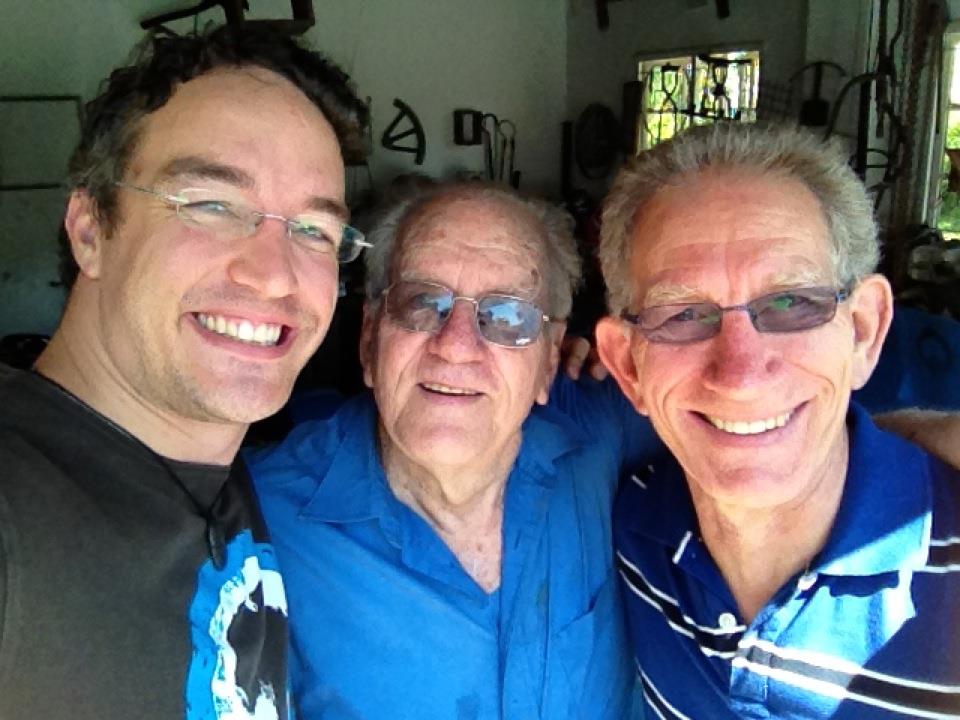
Three Black Boys. Different Ages. Equally Silly.

Malcolm Black, my Dad's, first guest post was  'Time to Retire'

Tuesday, October 13, 2015

Thin Slicing

When trying to wrap my head round something that is vast and scary, I have started trying the idea of 'Thin Slicing'. Asked for a super-super-summary of most of the reading I have done on happiness and learning, I would say the two key things are (1) create space, and (2) create meaningful connections. We remember things when they are meaningful to us and we have the energy and time to chew. Things are meaningful when they are connected to other things that matter to us.

Thin Slicing involves looking at just one aspect of something, and then looking widely to find how that connects and relates to other things. Same aspect. The Kevin Bacon game, but for ideas. Instead of figuring out how many degrees of separation between an actor and Kevin Bacon, you take something that doesn't seem to matter to you, and find how many connections that do matter to you there are, to get to that idea.

School always used to be divided into subjects. Ideas divided into folders. People divided into tribes. That never worked. Things get fuzzy. Tags or Labels for connections are far more powerful. They allow for us to connect dots and make division obsolete. That is the heart of creativity.


Monday, October 05, 2015

What is the it? (with Meg)

Megan Butler is a regular guest poster on Swart Donkey. We had a chat...

Trev: 
One of the interesting philosophical dilemmas working in the financial industry is 'identifying your value add'. When you dig holes or build trucks, you see what you have done. The more abstract the task, the more it plays a facilitative role, the harder it is to be completely sure that the task, absent you, would have been worse. Beyond a point, I don't think people are working for their salaries. Identity and meaning get tied up into the purpose of what we do every day. 'What do you do?' is short hand for 'Who are you?' and 'What matters to you?'


Meg:
By the same token, most of us will instinctively trot out a short CV when introducing ourselves or others. Somehow it's much easier to say 'I'm an actuary and I teach' than to say 'I love the scent of vanilla, reading and long walks'. Although what we do should be the truest reflection of ourselves (after all, we spend most of our lives "doing"), I don't think that it is necessarily the case for most people. How many people can honestly say that their work is their hobby?

Trev: 
It may not be their hobby, but it is their time sponge. It is what lets them soak up any excess 'what next time'. We don't wake up and think, 'Is there a reason I need to go into work today'. We go. It is a habit. But many of the other things that are important to us are not habits, including hobbies. We wait for rare moments of inspiration. In the mean time, time passes, so if on reflection we are uncertain whether our time has added value, we can get a little miserable. Those moments of reflection when we think whether it was all worth while?

Meg:
And what is the 'it' that we are assessing? This is perhaps the more interesting question, that is considerably more challenging to explore. If your work and your life are interchangeable there is arguably something missing. But as you say, work is a time-sponge. It is sometimes easier to churn out another delivery than to take a deep breath and ask "Is this what I want to make up my life?" And that is really a challenging question if you don't like the answer. Changing it requires all sorts of courage.

Trev:
It becomes rather easy to go with the flow. If the thing we are presented with seems like what we expect, we just get on with it. Stepping back is rare when we pack our days full. There is always a trade off between 'what is the best way to do this?' and 'how can I get this done?'. If something is once off, it is normally said that it is worth just getting it done. If you are going to do it again and again, then there is a lot that can be gained from more preparation time. The challenge with life is we do only get one. As you have pointed out before, not choosing has its advantages. Getting the balance between space and action is tricky.

Meg:
It's also a question of how much of a specialist you want to be. Before the industrial revolution, most families were at least competent at most things needed to keep body and soul together: you grew and reared your own food, cooked everything from scratch and made your own clothes. As our work moved from generalised to specialised we lost many of the skills considered non-essential but still greatly admire those with a variety of skills. What we miss is that it is almost impossible to specialise at everything and even being generally competent at everything was never really feasible.

Trev:
I think we have taken our level of incompetence in some areas to extremes. I do see the value of what Tim Ferriss calls 'Selective Ignorance'. By ignoring some things you can focus your energy more productively. But I think we lose some basic life competence. You don't get better meals by not being a competent cook. It is not more efficient to ask someone else to make you a coffee because you don't know how. There is value in 'low value tasks' other than factory line comparative advantage. There is also perspective in attempting tasks outside your speciality.

Meg:
It really is a question of priorities and some conscious choosing. We can't be fantastic at everything. We are unlikely to even be good at everything but there are going to be things we really should be good at and lots of things where we scrape by and okay to simply be okay. There are also going to be plenty of things that we are never going to get right or even start to learn. Sometimes those decisions are taken out of our hands and that can help reduce our choices to manageable ones.

Trev:
We do need to prioritise. I also think we need to let go of using 'which things we are good at' to justify our choices in some places. A base of competence in life, things you enjoy, and relationships gives you the energy to find an area to 'be fantastic'. Making your own bed, and knowing how to buy jam aren't things you should outsource in search of that thing you are the best in the world at. Having areas of life where you aren't competing, you are just appreciating, reduces the philosophical angst of thinking you might have gone through life and not achieve anything of value.

Meg:
It takes courage to put aside that thing you are awesome at, but hate, and focus on the thing you love, where you are, at best, average. In theory, the 10 000 hour rule means that with enough practice we should all become world-class at these activities. However, it represents a big risk. In high school, I had a friend who was really gifted at maths. She declined to do advanced maths simply because she wanted to study drama and this would not be of any use to her. That's pretty wise when you are 15. 


Other posts by Meg:


Sunday, August 02, 2015

Black One

When we listen to a language we don't understand, there is just a string of sound. The idea of spaces in between words for reading wasn't the way writing started either. Scrolls were just strings of letters. Punctuation to help us understand came later (Emojis even later). The same is true of the way we see. Part of our ability to see in 3 dimensions comes from memory. We rapidly recognise objects and from their size, and the relationship we expect between them, our minds are able to create the world we see. A mass of intermingled blue, green, and brown becomes the sky, leaves and a tree.

Meaning creates our world. Things that matter have meaning. What we see depends on what we've seen. The rest is a blur of sound, colour, smells, objects, and people. Game of Thrones is nasty to us. It makes characters meaningful to us before it gets rid of them. We are unaffected by the string of deaths in battle scenes. Create a connection, and a single death can be gutting.

Part of what fascinates me with Mentalists as magicians is their ability to add meaning to the world. The incredible memory tricks come through paying attention and creating connections. They 'build worlds' in their heads with paths between ideas that matter to them. They see the same blur of a world going past as we do, but they have learnt more of the words. They have learnt more of the sounds. They have learnt more of the smells. All these different sources of flavour create a richer world.

Three shades of Black - Grandfather in trademark overalls in the workshop

One blur for me has been mechanical things. My Grandfather is at his happiest when he is elbow deep in grease in his garage and my Dad did mechanical engineering. It is therefore weird that I am not 'mechanically minded'. This is not true though. I just haven't learnt the language. So when my brother who has done the Cape Epic asked me what commuting bike I bought in London 7 years ago, my answer was a 'Black One'. I understand the language of colour.

Everybody knows a Dave. One of my favourite Dave's is my brother.

It is time for all that to change. Yesterday my brother joined me in a Bike shop to point out the options. I went into another one this morning, and will check out another one this afternoon. It is still all a blur to me, but it is starting to matter. Once I actually get on my bike and start riding, new blurs will start making sense. I am looking forward to discovering the bike lanes of London and surrounds. The ones that don't head into the centre of town and work. The ones that aren't competing with Big Red Busses. Those busses made me put the 'Black One' aside to gather dust. In Bus v Trev, Bus wins everytime. Busses scare me more than sharks or terrorists.

I am looking forward to seeing how getting on a bike changes the way I see the world.

Friday, July 03, 2015

Time to Retire (Malcolm Black)

Guest Post

My Dad is the one person who gets my humour. I am the one person who gets his. It's ours. Beyond that, we have had to make our way through life finding people who can tolerate our silliness. One of the things that makes my Dad a particularly special man is how our relationship has transitioned into a friendship. We have a lots of shared interests and my life is richer because of him. I was super chuffed when my inbox delivered his guest post this afternoon. Dad and Bev, through their business Potential Unlimited, help people embrace the transition into retirement through the creation of a fulfilling and meaningful lifestyle.


Time to Retire
by Malcolm Black

Retiring? Why do you need to retire and what are you retiring from? Well I suppose we have come to understand by now what this is supposed to mean. We work at making a living from the time we leave school, or from a tertiary institution, build a career working in one company or moving around as life takes us and then the day comes when someone higher up the corporate ladder tells us we have to retire. We have reached 60 or 65 and we have to step out the door of the working world.

If we have a good pension fund and have been saving a bit extra because we have been financially astute and planned well, we may be looking forward to the day with excitement and anticipation. Now we can do all the things we have never been able to do, and we will be free to do just as we like. Play golf all and every day, or watch tennis whenever we want (my personal dream: to take two weeks to do nothing other than have bacon, eggs, toast and tea for breakfast, and watch Wimbledon from start to finish, not missing a single game, while snacking on biltong and nuts, and having high tea with strawberries and cream!)

All we have to do is manage our nest-egg, stay healthy and we can have a ball for as long as we live, which can be up to 30 years for many people these days. The reality is that for many of us this is not the way it turns out. Loss of work often means loss of identity, loss of status, loss of friends and loss of meaning. Those dreamed of day long leisure activities turn out to lose their glow when that is all there is to do. In the right quantity and when our lives are balanced they are most enjoyable, but when purpose and meaning go out of our lives we often become lost and despondent. The research literature on retired persons has shown this to be the case for many retirees. As Victor Frankl says, "Our search for meaning is the primary motivation in our lives." (Man's Search For Meaning)


And when the day to retire comes and we do not have a great pension and very little money saved we may lament and gnash our teeth. We may think we cannot go and do the things our hearts desire as we still need to earn a living and could feel cheated.

This may in fact be a blessing in disguise, as we will need to keep ourselves on the go, requiring mental and physical stimulation from an ongoing purpose and sense of meaning. What will help to add to a little sparkle and pleasure to our lives is if we focus more and more on what turns us on and fills us with enthusiasm. This is the time, if we have not done it already, to steer our work and play towards the things we are most passionate about. It is a time to expand beyond the mundane, focus on the joys of now, and just be focused on the next step.